Respectus Philologicus eISSN 2335-2388
2026, no. 50 (55), pp. 30–44 DOI: http://doi.org/10.15388/RESPECTUS.2026.50.3
On Linguistic and Visual Construction of the “Cool Grandma” Identity on TikTok
Svitlana Shurma
Tomas Bata University in Zlín, Department of Modern Languages and Literatures
Štefánikova 5670, 760 01 Zlín, Czechia
E-mail: shurma@utb.cz
ORCID iD: https://orcid.org/0000-0002-2183-2338
Research interests: cognitive poetics, MCDA, digital communication, and the rhetoric of violence
Khin Wee Chen
Masaryk University, Department of Media Studies and Journalism
Joštova 218/10, 602 00 Brno, Czechia
E-mail: 250793@muni.cz
ORCID iD: https://orcid.org/0000-0002-9477-751X
Research interests: political discourse, with a regional focus on Malaysia and Singapore, the role of humour in political communication, and media consumption patterns
Abstract. Grandfluencers who successfully ageing are frequently labelled “cool”, yet the intersection of age and gender remains neglected in studies of digital coolness. This study examines how nine TikTok grandfluencers, each with over 100,000 followers, construct “cool ageing” through linguistic and visual cues, drawing on 27 of their most-viewed videos. Combining multimodal critical discourse analysis with a social semiotic approach, the sampled videos are treated as a macro-genre that governs how these creators present themselves to their audiences. Linguistically, coolness rests on simple syntax and a fragmented, spoken-language register that favours deliberate casualness. Humour and theatricality are the central multimodal tools, working through gaze and body movement, and extended by additional cues such as fashion, memetic actions, and video editing. Together, these strategies indicate that “cool ageing” on TikTok is a platform-shaped performance rather than an incidental effect of visibility. The study contributes to research on digital communication, platformisation and the self-presentation strategies of older grandfluencers.
Keywords: multimodal discourse; semiotics of cool; humour; age; cool grandma.
Submitted 22 April 2026 / Accepted 20 August 2026
Įteikta 2026 04 22 / Priimta 2026 08 20
Copyright © 2026 Svitlana Shurma, Khin Wee Chen. Published by Vilnius University Press. This is an Open Access article distributed under the terms of the Creative Commons Attribution License CC BY 4.0, which permits unrestricted use, distribution, and reproduction in any medium provided the original author and source are credited.
Introduction
Dai (2025) argues that social media alters how ageing is discussed and publicly understood. Online discourses of “successful ageing” and “graceful ageing” reinforce societal norms around ageing (Stončikaitė, 2024; Xu, 2021), pressing both younger and older adults to conform to age-related expectations of appearance and behaviour (Sun, Li, 2025). Platforms such as Facebook, YouTube, Instagram and TikTok enable these discourses about ageing to circulate globally (Cotten, et al., 2022). Older adults themselves share narratives on these platforms that can challenge or reinforce age-related stereotypes. Some have built large followings and have become a new type of celebrity known as “grandfluencers” (Ng, Indran, 2023; Saeed, et al., 2026). This has generated growing scholarly interest in social media representations of older adults (Ng, Indran, 2023; Wang, Lin, 2025). Previous research has demonstrated that older social media influencers challenge ageist stereotypes (Mueller-Bryson, et al., 2026; Saeed, et al., 2026; Ng, Indran, 2023), negotiate later-life identities through digital self-presentation (Roubal, 2023; Yan, et al., 2024), and reshape cultural understandings of ageing in online environments (Ghosh, 2023). In mass media and online, grandfluencers are frequently labelled “cool” (see Barsamian, 2017; Payne, 2025). Coolness has been studied in psychology, cultural studies, and discourse analysis (Pountain, Robins, 2000; Blommaert, 2015; Danesi, 2016; Wiggins, 2020). However, within research on digital coolness and influencer culture, the intersection of age and gender remains neglected. This gap matters because coolness scholarship has been built almost entirely on youth culture, leaving no account of what it means for an older woman to claim coolness, or of how that claim is received rather than simply performed.
This study investigates the multimodal construction of the “cool grandma” phenomenon on TikTok among nine older microcelebrities (termed “influencers” in the literature cited above), each with over 100,000 followers, drawing on Multimodal Critical Discourse Analysis (Bateman, et al., 2017; Kress, Bezemer, 2023) and Social Semiotics (Kress, van Leeuwen, 2001). These frameworks suit the problem, since grandfluencers construct coolness jointly through language and visual performance, and neither mode alone accounts for the effect. The research problem, then, is how coolness and ageing are negotiated across linguistic and visual modes in this genre, a question the ageing-online and coolness literatures address separately but not together.
The analysis proceeds in three stages. It first examines the videos’ linguistic resources for constructing casualness and cool affect, as well as syntactic features associated with spoken discourse. It then turns to multimodal humour, examining how semiotic resources interact across modes, tracing how age-related coolness is constructed in platform-mediated communication. It finally turns to non-linguistic cues of staging, theatricality, and paralanguage that together construct “cool ageing” alongside speech. This study pursues three objectives: to identify the linguistic markers of casualness and cool affect, to examine how multimodal humour constructs coolness, and to establish how non-linguistic staging and paralanguage contribute to coolness.
1. Background
1.1 Semiotics of “cool”
“Cool” has been defined as an oppositional attitude characterised by resistance to authority or dominant social stereotypes (Pountain, Robins, 2000, p. 19). Neither stable nor homogeneous, it is a symbolic status that shifts across generations (Pountain, Robins, 2000, p. 21; Danesi, 2016, pp. 38–39) while retaining its status as a form of “social attractiveness” (Danesi, 2016, p. 41). Coolness is also performative, as it is expressed through bodily movements, gestures, vocal modulations, the management or suppression of embarrassment, dress codes and modi vivendi (Danesi, 2016, pp. 38–40). A cultural construct built from signs (visual cues, language, fashion, music, and behaviour), cool functions as an identity marker within social groups. These signs acquire “semiotic meaning” (Wiggins, 2020, p. 33), and for something to be read as cool, the perceiver must recognise it as such (Wiggins, 2020, p. 92). “The semiotics of cool” is how humans attribute meaning to those signs (Wiggins, 2020, p. 92), for example, through “mediated forms of communication” (Wiggins, 2020, p. 32). Cool, therefore, operates as a metapragmatic, indexical phenomenon through which meaning is produced and negotiated (Blommaert, 2015, p. 18). Danesi (2016) theorises coolness as an adolescent phenomenon emerging in the second half of the twentieth century, one that members of these generations may retain into later life.
1.2 Short video as a multisemiotic macro-genre on TikTok
Communicative needs on digital media platforms are met through genres: recurring solutions drawing on one or more semiotic modes to convey a message (Bateman, 2017, p. 168). Digital genres are transmedial and transmodal, forming “emergent clusters within multidimensional spaces” (Bateman, 2024, p. 29; Bateman, 2017, pp. 168, 171) that shift and overlap as platforms evolve.
On TikTok, short videos function as a “multisemiotic artefact” (Bateman, 2021a), integrated into familiar interactional formats that carry “interpretative frames and expectations” (Bateman, et al., 2017, p. 129). The platform’s affordances determine the “bundles of rhetorical strategies” available to creators, each drawing on different semiotic systems (Bateman, 2021, p. 856). Short videos may thus be conceptualised as a macro-genre “constituted by the functions of communication” (Fludernik, 2000, p. 280) rather than simply a technical format. They push creators toward recognisable recurrent procedures (Fludernik, 2000, pp. 281–282), governed by the platform’s memetic and medium-related constraints. Over time, repeated participation in these formats produces shared expectations around how content is made and received, generating “genre knowledge” and the flexibility to combine short-video conventions with other genres, such as conversation (Bateman, 2024, pp. 17–19). These structural properties define a “genre space” (Hiippala, 2014, p. 114), the range of semiotic choices available within the macro-genre to realise a particular rhetorical strategy. In practice, creators use this space to produce subgenres, such as vlogs, stitches/duets, or self-help, that vary in purpose, communicative moves and rhetorical strategies.
The following formal features (sensu Bateman, et al., 2024, pp. 72–73) characterise short videos: the length is defined by the platform’s technical medium; gaze, body movements and social distance are framed through the digital camera; mixing and mode-switching allow music, oral speech, written text, sounds and visual cues to co-construct meaning. Lastly, using platform affordances, content creators construct a coherent performed identity via verbal and paralingual behaviour, visual representation, relatability, humour, feelings, and compressed narrative structures.
Beyond genre, short videos are also governed by the logic of virality: content that “spreads more widely and quickly than expected” through broad network reach and word-of-mouth-like circulation (Hemsley, Mason, 2013, pp. 139, 144). Viral trends are content or behaviour that draw wide attention and rapid imitation across platforms, which platforms actively encourage users to circulate (Lee, Umback, 2026, p. 324).
“Cool grandma” became a viral trend on TikTok and Instagram, giving rise to microcelebrities such as Grandma Droniak and others discussed below. Using short videos, microcelebrities, commonly called “influencers” in public discourse, construct public personas, keeping content circulating to establish parasocial relationships with audiences (Marwick, 2015; Kim, McDonald-Liu, 2023). “Cool grandmas” participate in and reveal discourses on how individuals view their own ageing. The following case study examines how selected microcelebrities construct “cool ageing” through the multimodal resources of TikTok videos.
2. Materials and methods
The condition of recognising a “cool grandma”, established above through Wiggins, governs how this study identifies one within the dataset. “Cool grandma” is aged 60 or older, or presents herself as such, and her coolness is recognised by her own audience rather than assigned by the researchers, as evidenced by the “#coolgrandma” hashtag and similar audience-generated labels. Her content foregrounds at least one of the markers identified in this study: an oppositional stance, performative bodily display, or resistance to age-based stereotypes. Her microcelebrity status (having more than 100,000 followers) was built through this persona. Older public figures whose visibility rests on another basis, such as an acting career or political office, were therefore excluded.
The TikTok data (see Table 1) were collected via an app walkthrough method (Light et al., 2018) on May 23, 2025; future research would benefit from comparative analyses across additional platforms. The English hashtag search (#coolgrandma, #grandma, #nanny, #granny) largely restricted the sample to English-speaking/searching audiences. One Ukrainian creator was nevertheless algorithmically surfaced despite posting in Ukrainian, reflecting the platform’s algorithmic bias (Matlach, et al., 2025). The analysis focused on each creator’s most-viewed videos, since view count reflects reach, not a video’s contribution to constructing the “cool grandma” identity, which this study independently establishes through audience labels such as “cool” and “baddie” in comments.
Following the ethical guidelines of the Association of Internet Researchers (Ess and AoIR Ethics Working Committee, 2002), the study treats the influencer videos as publicly distributed digital artefacts. The authors assessed the study as low risk, as microcelebrity discourse is highly public and monetised (they often have parallel accounts on YouTube and Instagram, and some appear in the media), and no personal data was sought or used. Videos are in the public domain and referenced in the bibliography like other artefacts.
To preserve contextual integrity, TikTok usernames are used as published in their accounts. The personas projected in short video content are curated for the platform and do not necessarily reflect creators’ offline selves. This does not diminish the authenticity of the content they produce for their audiences.
The case study employed purposeful sampling by “selecting information-rich cases for study in depth” (Patton, 2002, p. 230). The data were collected based on popularity (above 100K subscribers/followers); however, it suggests (see Table 1) that US users dominate Anglophone TikTok. The three most-viewed videos per creator were analysed, along with their 10 to 15 most popular comments (by number of likes), anonymised for research. TikTok allows users to display videos on their accounts based on their popularity, which is determined by a combination of factors such as the number of views, likes, and other forms of engagement (Topictree, 2025). Among these, the videos with the most views were manually selected. On the access date, follower/like counts and video views were collected from publicly available TikTok statistics. A limitation of the case study outlined below is the TikTok platform’s policies on video archiving, which do not guarantee long-term access to the data.
Table 1. Microcelebrities’ popularity and dataset metadata
|
TikTok nick |
No. of |
No. of likes |
Video identifier |
Year of publication |
No. of views for the most viewed video (2025) |
|---|---|---|---|---|---|
|
Grandma Droniak |
14.9M |
458.6M |
Reply to ... (79.9M) |
2021 |
79.9M |
|
i could not say no to a first date... (71.8M) |
2023 |
||||
|
i slay while they decay… (57M) |
2023 |
||||
|
Granny Chainz |
5.7M |
100.4M |
Teaching Granny Meme Songs (153.1M) |
2019 |
153.1M |
|
Teaching Granny Movies... (32.1M) |
2019 |
||||
|
Granny makes Chinese pizza... (30.3M) |
2020 |
||||
|
Grandmagreat |
3.4M |
48.5M |
NO ONE IS PERFECT (12.7M) |
2021 |
14.2M |
|
Dont forget! (14.2M) |
2023 |
||||
|
Tou.are doibg the best tou can (11.5M) |
2023 |
||||
|
Our Filipino Grandma |
1.8M |
65.9M |
Reply to ... (33.8M) |
2021 |
38.5M |
|
Reply to ... (29.5M) |
2021 |
||||
|
There were no babies harmed in the making of this video... (38.5M) |
2021 |
||||
|
Giovanni and Doris |
1.2M |
25.2M |
#sassygran (13.4M) |
2020 |
13.4M |
|
#sassygran (9.2M) |
2020 |
||||
|
Those eyes and brows for a lifetime (12.7M) |
2025 |
||||
|
YourChubbyVintageNana |
997K |
13.5M |
POV: You’re my houseguest … (3.8M) |
2022 |
5.2M |
|
If you are having a difficult time...(5.2M) |
2023 |
||||
|
Who wants a cinnamon roll? (5M) |
2023 |
||||
|
Vo Izaura Demari |
370.9K |
4.9M |
Quando acordei hoje de manha, ... (9.6M) |
2023 |
12.4M |
|
Feliz Páscoa!... (12.4M) |
2024 |
||||
|
Look exclusivo... (5.2M) |
2024 |
||||
|
Baba Masha |
223.4K |
6M |
Iak klasno koly je vnuky, iaki zavzhdy vezut meni najkrashche! [Great to have grandchildren who always bring me the best!] (4.9M) |
2024 |
5.1M |
|
Ne zabuvajte prybyraty na tsvyntari!.. [Do not forget to clean the graves!] (5.1M) |
2024 |
||||
|
Ofigienna rybalochka z onukamy!... [Perfect fishing with my grandchildren!] (3.2M) |
2024 |
||||
|
Elsa12 |
132.5K |
2M |
Enjoy my new dress... (569.9K) |
2020 |
10.5M |
|
Which one do u like? (10.5M) |
2020 |
||||
|
Which one do u love? (664K) |
2020 |
The qualitative analysis draws on the 27 most-viewed videos from the selected grandfluencers’ accounts, using Multimodal Critical Discourse Analysis (Bateman, et al., 2017; Kress, Bezemer, 2023) and Social Semiotics (Kress, van Leeuwen, 2001). The analysis examines the multimodal resources creators use to project meanings aligned with their audience’s cultural expectations. Abductive reasoning is applied by starting from observed semiotic clues and matching them to existing knowledge to reach a conclusion (Moriarty, 2002, pp. 25–26). Categories were developed inductively through repeated examination of the dataset. Linguistic cues (syntax, orality, fragmentation, address strategies) and visual cues (gaze, body movement, social distance, mode-switching) were manually identified and agreed upon by both researchers. The cues were mapped to the aspects of coolness identified above: bodily movements, gestures, vocal modulations, the management or suppression of embarrassment, dress codes and modi vivendi. Transcriptions (Bateman, et al., 2017, p. 147) were used for the analysis of salient features related to bodily movements, gestures, dress codes and other aspects of modi vivendi. Due to a small sample size, a single researcher conducted the final coding, and no intercoder reliability statistics were deemed necessary, though the authors acknowledge the limitations of such an approach.
3. Results: online construction of “cool” ageing
Analysis of the 27 videos by 9 older TikTok microcelebrities (Table 1) reveals several patterns in the online construction of cool ageing. The short videos in the dataset represent the following subgenres: vlogs (videos of Doris, Grandma Droniak, YourChubbyVintageNana, Baba Masha), dance videos (Grandma Droniak), comedy/sketch videos (Granny Chainz, Our Philipino Grandma), motivational/self-help videos (Grandmagreat, Baba Masha), beauty/fashion content (elsa12, Vo Izaura Demari, Doris), mixed with elements of reaction, meme and promotion videos, which realise the genre space above without claiming an exhaustive typology. The analysis below examines linguistic resources, multimodal humour, and non-linguistic cues in the construction of coolness.
3.1 The role of language in the construction of “coolness”
In short videos, the linguistic sign – English, Ukrainian (Baba Masha), Korean (elsa12), French (elsa12), and Portuguese (Vo Izaura Demari) – appears as hashtags, captions, subtitles, on-screen text, or speech from visible or off-screen participants.
Message length depends on subgenre: vlogs require the longest narratives (Baba Masha, 372 words), while fashion and comedy videos, lacking narration, require fewer words (e.g., Vo Izaura Demari). Overall, the linguistic component of the messages shows low syntactic complexity, strong orality, and conversational fragmentation. Although these features reflect broader social media communication conventions (see Jones, 2023), we argue that their adoption by grandfluencers challenges stereotypes about older adults’ speech (Hummert, et al., 1998; Ruscher and Hurley, 2000) and contributes to the performance of “cool grandma” identity.
Several features in the grandfluencers’ speech serve a strategy of informality that establishes intimacy (Xu, Weninger, Chen, 2025) and present them as modern, authentic, and relatable. For instance, short clauses connected with simple coordination (and, Ukr. a, i) or juxtaposition imitate spontaneous conversation even when the audio shows signs of editing (e.g., Baba Masha’s videos). In the English corpus and appears 66 times against so at just 6. Independent simple declarative sentences are frequent (145 in total): e.g., You look pretty today; It’s your strength. The corpus also leans heavily on parataxis: All I want is a free dinner. I’m not even going to bring my wallet or my purse (grandma_droniak, 2023).
Ellipsis is another recurrent feature, with 199 clauses missing a subject, verb, or both, particularly in expressive or humorous content. Visual cues, prosody and emojis often support the interpretation of such elliptical messages. For example, the caption Teaching Granny Movies 😂 signals a humorous reading. Repetition also contributes to the impression of spontaneity: e.g., Oh, look at her – pretty. Look at her (sassygran, 2020). In contrast, the speech of YourChubbyVintageNana appears more pre-drafted, coherent, and structurally elaborate, though little laughs are inserted to imitate spontaneity: e.g., Years ago, my mornings were so hectic and rushed, but these days I have solitude and time to spare (shifferdiane, 2023).
The messages also exhibit vernacular language, including slang, dialectal forms, nonstandard grammar, and code-switching. Typical TikTok expressions, such as #fyp “for your page” or GRWM “get ready with me”, appear both as hashtags and video formats. GenZ/millennial slang (prosnulas’ v resursi “woke up my vibe”, lajvhak “lifehack”), non-standard grammar (I don’t want to associate with nobody (grandma_droniak, 2021)), and multilingual practices (e.g., Korean + English in elsa12’s videos) are common across the corpus.
Microcelebrities use linguistic hooks to capture audience attention, addressing viewers directly through deictic you (96 instances, including in hashtags), tag lines, imperatives (23), and exclamatory clauses (22). For instance, two of Grandmagreat’s videos open with a soft imperative: wait, don’t go. Imperatives cluster in motivational/self-help videos, while exclamatory sentences appear in all of Baba Masha’s captions. Deictic you is used creatively in elsa12’s videos, where English-language references such as Ha how you like that? or I know you are obsessed with me address a global audience. Grandmagreat uses metaphoric (she appeals to light inside a person as a source of strength), encouraging (you are doing great; ... knowing that you have the strength, because you do) and audience-oriented (I/we love you; beautiful friends) language that projects the image of a wise but modern, and inclusive woman. YourChubbyVintageNana, in turn, projects the stereotype of a rural white American grandma, through references to vintage domesticity and traditional homemaking (Sawchuk, 2009, p. 176). Finally, Grandma Droniak, Baba Masha, YourChubbyVintageNana and Grandmagreat use contrast rhetorically, somewhat similarly to marketing messages (Kol, et al., 2026): e.g., And of those dark days when you don’t feel any life from any source, remember your light, your strength (grandmagreat, 2023). Evaluative vocabulary such as beautiful, pretty, klasno “cool”, etc., further appeals to audiences through “formatted authenticity” (Georgakopoulou, 2025). Although these linguistic strategies vary by creator and subgenre, together they construct a “cool grandma” persona that pushes back against ageist and gendered expectations of how older women should speak, favouring casualness and self-assertion over the deference such expectations imply.
3.2 Multimodal humour and “coolness”
Several videos in our dataset rely on multimodal humour, small sketches showcasing humorous situations or verbal wit, a discursive resource through which coolness is performed. In the memetic space of TikTok, these appeal to “humour communities” (Attardo, 2020, pp. 203–204), and several microcelebrities (often with the help of their grandchildren) build an online identity interpreted through humour. The most prominent creators who rely on humorous or sarcastic messages are Grandma Droniak, Our Filipino Grandma, and Granny Chainz. Several videos of Baba Masha and Doris can also be labelled as humorous.
Grandma Droniak’s humour is quite declarative in her accounts of dates and boyfriends: e.g., she tells viewers that she expects a free dinner from her date. It seems that Grandma Droniak interprets the idea of “Queenagers” (Hobsbawm, 2023) in a way where independence means asserting agency over relationships (I don’t want associate with nobody) or self-validation (This is my outfit. If he doesn’t like it, he could leave). She projects a self that is loud (also through the use of intonation and elevated tone of voice) and provocative: I slay while they decay. The bold and ridiculing behaviour of the content creator is coupled with a form of what Attardo (2020, p. 20) describes as “triumph over an adversary” that creates a humorous appeal and high engagement.
Like Grandma Droniak, although through a less confrontational form of self-irony, Baba Masha incorporates light verbal humour in her narratives: e.g., kovbasa tuha jak moia zhyzn “sausage as hard as my life”, chut’ ne g tunel’ v Ameryku “almost dug a tunnel all the way to America”. She also tries to be a “Queenager” by wearing what is typically criticised as not suited to her age or by participating in genres typical of TikTok.

Fig. 1. Our Filipino Grandma’s signature gesture. The image is illustrative and was generated by prompting ChatGPT Version 1.2026.183.
Our Filipino Grandma’s humour is created by the incongruity between what the viewers see performed and common pickup or slapstick puns, such as “Help!” I have fallen for you – the camera shows the creator lying on the floor at this moment (ourphilipinograndma, 2021). Her signature gesture (a modification of a popular in Korean and some other Asian cultures index and thumb “gun” pose under the chin, coupled with upper teeth biting the lower lip, see Fig. 1) at the end serves as a nonverbal keying signalling intended interpretation (Attardo, 2020, p. 218). The viewers find the influencer “funny” and react to the humorous situations by leaving comments like “I’m dead 😂😂😂”.
In one of Granny Chainz’s videos, the keying is in the exaggerated sounds, facial expressions, and exclamations such as wow that accompany the sketch (thegrannychainz, 2020). Both Our Filipino Grandma and Granny Chainz seem to embrace the carnivalesque nature of the play they perform in public, which can also be viewed as a way of liberating (Sicart, 2017, p. 11) from stereotypes around ageing (e.g., being matronly and serious).
And finally, bold, nonchalant reactions to her husband’s alleged disloyalty or her daughter’s hat create humour in the conversations between Doris and her grandson.
Although the humour strategies described above differ in form, they collectively construct a “cool grandma” identity by presenting these women as transcending the embarrassment of their age via playfulness and engagement with contemporary digital culture.
3.3 Non-linguistic cues of “coolness”
Non-linguistic cues of coolness range from setting and background to performed theatricality, capturing both overt dramatic self-display and performances of “realness” (Gran, 2025). This theatricality resides in “intentional staging” (Gran, 2025, p. 4). Exaggeration is central: it governs bodily movements, intonation, stress, and the background sounds or music.
For example, Vo Izaura Demari’s and elsa12’s videos contain no creator’s speech. In Vo Izaura Demari’s case, even the background music, Habanera from Carmen or Jose Basso’s La Cumparsita, has no lyrics. Paralanguage matters too: at the end of the videos, the influencer looks directly at the viewer (see Fig. 2). Visually different, but no less theatrical, are videos of elsa12, though here the creators’ luxurious outfits and imposing postures take centre stage: ageing beautifully is what becomes noticeable. Her videos are edited to fit the rhythmic tunes. Together with other people who appear in the videos, elsa12 challenges ageist stereotypes and plays with societal expectations of typical but inelegant, ageing vs luxurious styles and intricate make-up styles in Western and Chinese fashion. The “unsaid” in this case, this study argues, is a type of “cool” detachment: the words are not important in the message, while the gaze and posture are, as a kind of provocation.
It might be argued that Doris falls into a similar group of creators. She is stylish and chic. One video features a series of studio photographs of Doris’s younger years, set to Madonna’s Material Girl (sassygran, 2025). Unlike the Brazilian and Chinese influencers, she does not address the audience directly; in the videos, she speaks to her grandson, invisible behind the camera. The theatricality here is in “not-acting as performing oneself” (Gran, 2025, p. 4), whether consciously or prompted naturally by the dialogue with her grandson. All three of her videos project the image of what viewers themselves call a “baddie”, conveyed through what they see and hear onscreen.
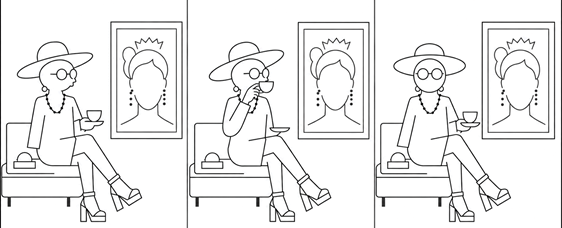
Fig. 2. Vo Izaura Demari’s shifts of gaze in a static frame (voizaurademari, 2023). The image is illustrative and was generated by prompting ChatGPT Version 1.2026.183.
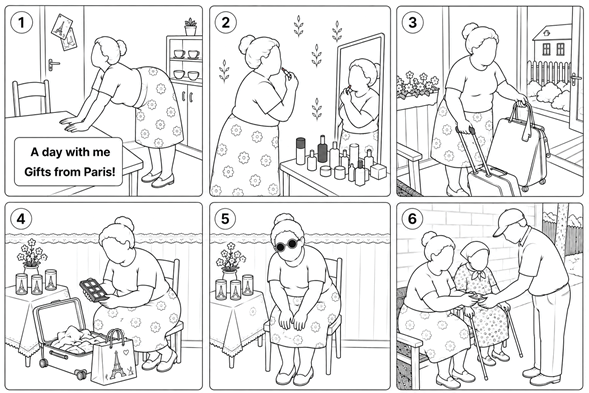
Fig. 3. Baba Masha’s vlog: a series of shots in an unboxing video (mariadumal, 2024). The shots capture the “morning routine” of the grandfluencer (boxes 1-2), unboxing presents allegedly from Paris (boxes 3-5), and sharing a gift of chocolate with her village friends (box 6). The image is illustrative and was generated by prompting ChatGPT Version 1.2026.183.
At the same time, in our corpus, another group of creators produces content that relies on “theatrical self-presentations” (Gran, 2025, pp. 5–6) as a memetic action. These are fully or partially performed sequences of actions based on a type of narrative: a funny sketch bordering on slapstick (as is the case of Grandma Chainz and Our Filipino Grandma), a story from one’s life presented through a sequence of shots (as is the case of Grandma Droniak, or vlog-type videos of YourChubbyVintageNana and Baba Masha, see e.g., Fig. 3), or motivational content with a zoom in on the addressing persona (as narrated by Grandmagreat and her partner). Here, theatricality may be fully internally driven, when the content creator controls (at least to a high degree) the process from idea to production, or externally driven, when the content reflects someone else’s interpretation of the microcelebrity’s self. The content, therefore, carries a further layer of mediation: the producer’s own interpretation of age.
Conclusions
TikTok short videos function as a macro-genre in which platform logic determines how coolness is performed. The empirical findings show that coolness is an indexical, multimodal performance accomplished in platform-mediated communication through the grandfluencers’ strategic orchestration of semiotic resources. At the same time, cool must be recognised by the audience to function, as evidenced by audience-generated labels and comments, not by view counts, which indicate only exposure.
The study shows that the “cool grandma” identity on TikTok is constructed through the interplay of linguistic and visual resources. Linguistically, grandfluencers rely on simple syntax, orality, fragmentation and ellipsis. Influencers employ a range of linguistic hooks to capture the audience’s attention while appearing authentic. Multimodal humour, internally and externally driven theatricality (paralanguage, outfits, narrative types) are central tools of digital coolness.
These practices allow “cool grandmas” to push back against ageist stereotypes by continuing their own sense of cool rather than adopting someone else’s, a pattern consistent with the generational continuity described above (Danesi, 2016).
Future research should compare this phenomenon across platforms. The underrepresentation of non-English creators is a limitation for subsequent studies to address. The intersection of age and gender also warrants further attention, as would a systematic account of the platform’s monetisation structures and labour dynamics, which this study’s design does not capture.
Acknowledgments
Svitlana Shurma is grateful to Dr Roman Trušník and Dr Libor Marek. The research complied with the Rector’s Decree RR/9/2023 of Tomas Bata University in Zlín (TikTok Application Warning) and the university’s cybersecurity guidance.
References
Attardo, S., 2020. The Linguistics of Humour. Oxford: Oxford University Press. https://doi.org/10.1093/oso/9780198791270.001.0001.
Barsamian, E., 2017. Hillary Clinton Gives the Cool Grandma Uniform a Print-on-Print Upgrade. Vogue [online]. Available at: <https://www.vogue.com/article/hillary-clinton-print-dressing-cool-grandma-celebrity-street-style\> [Accessed 17 April 2026].
Bateman, J. A., 2017. Triangulating Transmediality: A Multimodal Semiotic Framework Relating Media, Modes and Genres. Discourse, Context & Media, 20, pp. 160–174. https://doi.org/10.1016/j.dcm.2017.06.009.
Bateman, J. A., 2021a. Multisemiotic Artifacts between Modes and Media. Revista signos, 54 (107), pp. 842–866. https://doi.org/10.4067/S0718-09342021000300842.
Bateman, J. A., 2024. What is ‘Genre’? Theoretical Dimensions for the Analysis of Genre. In: Multidisciplinary views on discourse genre: a research agenda. Eds. N.M. Stukker, J.A. Bateman, D.S. McNamara, W. Spooren. New York: Routledge, pp. 10–46.
Bateman, J. A., Heller, V., Moschini, I., Sindoni, M. G., 2024. Genre Beyond Boundaries: Toward a Definition. In: Multidisciplinary Views on Discourse Genre. Eds. N. Stukker, J.A. Bateman, D. McNamara, W. Spooren. New York: Routledge, pp. 47–84. https://doi.org/10.4324/9781003335603-3.
Bateman, J. A., Wildfeuer, J., Hiippala, T., 2017. Multimodality: Foundations, Research and Analysis – A Problem-Oriented Introduction. Berlin/Boston: De Gruyter Mouton. https://doi.org/10.1515/9783110479898.
Blommaert, J., 2015. Meaning as a Nonlinear Effect: The Birth of Cool. AILA Review, 28, pp. 7–27. https://doi.org/10.1075/aila.28.01blo.
Cotten, S. R., Schuster, A.M., Seifert, A., 2022. Social Media Use and Well-Being Among Older Adults. Current Opinion in Psychology, 45, art. 101293. https://doi.org/10.1016/j.copsyc.2021.12.005.
Dai, H., 2025. Social Media and Age-Based Stereotypes: The Reinforcement or Alleviation of Ageism. Communications in Humanities Research, 53 (1), pp. 27–33. https://doi.org/10.54254/2753-7064/2025.LC20854.
Danesi, M., 2016. Cool: The Signs and Meanings of Adolescence. Toronto: University of Toronto Press. https://doi.org/10.3138/9781442673472.
Ess, C. and the AoIR Ethics Working Committee, 2002. Ethical Decision-Making and Internet Research: Recommendations from the AoIR Ethics Working Committee. Association of Internet Researchers. Available at: <https://aoir.org/ethics/?utm> [Accessed 30 April 2026].
Fludernik, M., 2000. Genres, Text Types, or Discourse Modes? Narrative Modalities and Generic Categorization. Style, 34 (2), pp. 274–292. Available at: <https://www.jstor.org/stable/10.5325/style.34.2.274>. [Accessed 2 June 2026].
Georgakopoulou, A., 2025. From “Being Real” to “Relatable Tales”: Formatted Authenticity and Stories in TikTok Short Form Videos. Narrative Works, 13 (2), pp. 11–34. https://doi.org/10.7202/1120141ar.
Ghosh, M., 2023. Female Instagram Elderly Influencers Countering the Ageing Narratives. Humanities and Social Sciences Communication, 10, art. 804. https://doi.org/10.1057/s41599-023-02323-4.
Gran, A.-B., 2025. Performing Not-Not-Me in SoMe: A New Theatrical Typology of Self-Presentation Online. Social Media + Society, 11 (1). https://doi.org/10.1177/20563051251315256.
grandma_droniak, 2021. Reply to ... TikTok. Available at: <https://www.tiktok.com/@grandma_droniak/video/6961117285448797446\>. [Accessed 25 May 2025].
grandma_droniak, 2023. i could not say no to a first date because its been too long and im not getting any younger. TikTok. Available at: <https://www.tiktok.com/@grandma_droniak/video/7197847511887858986\>. [Accessed 23 May 2025].
grandmagreat, 2023. Dont forget! TikTok. Available at: <https://www.tiktok.com/@grandmagreat/video/7257612264151321899\>. [Accessed 23 May 2025].
Hemsley, J., Mason, R. M., 2013. Knowledge and Knowledge Management in the Social Media Age. Journal of Organizational Computing and Electronic Commerce, 23 (1–2), pp. 138–167. https://doi.org/10.1080/10919392.2013.748614.
Hiippala, T., 2014. Multimodal Genre Analysis. In: Interactions, Images and Texts: A Reader in Multimodality. Eds. S. Norris, C.D. Maier. Amsterdam: De Gruyter, pp. 111–123. https://doi.org/10.1515/9781614511175.111.
Hobsbawm, J., 2023. Meet the Queenagers: The New Category of Worker in Your Office That’s Long Been There. Financial Post [online]. Available at: <https://financialpost.com/pmn/business-pmn/meet-the-queenagers-the-new-category-of-worker-in-your-office-thats-long-been-there\> [Accessed 22 September 2025].
Hummert, M. L., Shaner, J. L., Garstka, T. A. and Henry, C., 1998. Communication with Older Adults: The Influence of Age Stereotypes, Context, and Communicator Age. Human Communication Research, 25 (1), pp. 124–151. https://doi.org/10.1111/j.1468-2958.1998.tb00439.x
Jones, R., 2023. Discourse Analysis and Social Media. In: The Routledge Handbook of Discourse Analysis. Eds. M. Handford, J. P. Gee. Abingdon, Oxon: Routledge, pp. 427–440. http://doi.org/10.4324/9781003035244.
Kim, E., McDonald-Liu, C., 2023. Influencers with #NoFilter: How Micro-Celebrities Use Self-Branding Practices on Instagram. Computers in Human Behavior, 148, art. 107892. https://doi.org/10.1016/j.chb.2023.107892.
Kol, O., Zimand-Sheiner, D. and Levy, S., 2026. Crafting Influence in Social Media Advertising: How Creative Appeals and Message Strategies Shape Consumer Behavior. Journal of Theoretical and Applied Electronic Commerce Research, 21 (1), pp. 1–17. https://doi.org/10.3390/jtaer21010003.
Kress, G., Bezemer, J., 2023. Multimodal Discourse Analysis. In: The Routledge Handbook of Discourse Analysis. Eds. M. Handford, J. P. Gee. London: Routledge, pp. 139–155. https://doi.org/10.4324/9781003035244-12.
Kress, G., van Leeuwen, T., 2001. Multimodal Discourse: The Modes and Media of Contemporary Communication. London: Hodder Education.
Lee, J., Umback, J., 2026. The Viral Turn: Rethinking Virality in the Creator Economy on TikTok. Continuum, 40 (2), pp. 319–344. https://doi.org/10.1080/10304312.2026.2625794.
Light, B., Burgess, J. and Duguay, S., 2018. The Walkthrough Method: An Approach to the Study of Apps. New Media & Society, 20 (3), pp. 881–900. https://doi.org/10.1177/1461444816675438.
mariadumal, 2024. Iak klasno koly je vnuky, iaki zavzhdy vezut meni najkrashche! [Great to have grandchildren who always bring me the best!] TikTok. Available at: <https://www.tiktok.com/@mariadumal/video/7400339923473059077\>. [Accessed 23 May 2025].
Marwick, A. E., 2015. You May Know Me from YouTube: (Micro‐)Celebrity in Social Media. In: A Companion to Celebrity. Eds. P. D. Marshall, S. Redmond. Chichester: Wiley-Blackwell. pp. 333–350. https://doi.org/10.1002/9781118475089.ch18.
Matlach, P.-C., Castillo, A., Drath, C., Hevesi, E. F., 2025. Recommending Hate: How TikTok’s Search Engine Algorithms Reproduce Societal Bias. Available at: <https://www.isdglobal.org/wp-content/uploads/2025/02/How-TikToks-Search-Engine-Algorithms-Reproduce-Societal-Bias.pdf\>. [Accessed 6 May 2025].
Moriarty, S. E., 2002. The Symbiotics of Semiotics and Visual Communication. Journal of Visual Literacy, 22 (1), pp. 19–28. https://doi.org/10.1080/23796529.2002.11674579.
Mueller-Bryson, S., Shi, H., Ahn, R. J. and Zhao, X., 2026. From Granny to Granfluencer: How Older Influencers Are Challenging Age-Related Stereotypes via Fashion Portrayals and Affecting Consumer Responses through Social Media. International Journal of Advertising, pp. 1–32. https://doi.org/10.1080/02650487.2026.2665004.
Ng, R., Indran, N., 2023. Granfluencers on TikTok: Factors linked to positive self-portrayals of older adults on social media. PLOS ONE, 18 (2), art. e0280281. https://doi.org/10.1371/journal.pone.0280281.
ourphilipinograndma, 2021. Reply to... TikTok. Available at: <https://www.tiktok.com/@ourfilipinograndma/video/7027203097583684870\>. [Accessed 23 May 2025].
Patton, M. Q., 2002. Qualitative Research & Evaluation Methods. Thousand Oaks: Sage.
Payne, G., 2025. How to Be a Cool Grandpa. More than Grand [online]. Available at: <https://www.morethangrand.com/blog/how-to-be-a-cool-grandpa\> [Accessed 17 April 2026].
Pountain, D., Robins, D., 2000. Cool Rules: Anatomy of an Attitude. London: Reaktion Books.
Roubal, O., 2023. Older People and the Construction of Virtual Identities in the Digital Culture. OBM Geriatrics, 7 (2), art. 235. https://doi.org/10.21926/obm.geriatr.2302235.
Ruscher, J. B., Hurley, M. M., 2000. Off-Target Verbosity Evokes Negative Stereotypes of Older Adults. Journal of Language and Social Psychology, 19 (1), pp. 141–149. https://doi.org/10.1177/0261927X00019001007.
Saeed, M. R., Cohen, J., Yousaf, N., Sands, S., 2026. Granfluencers and the Power of Positive Ageing in Tourism Marketing. Tourism Management, vol. 115, art. 105397. https://doi.org/10.1016/j.tourman.2026.105397.
sassygran, 2020. #sassygran. TikTok. Available at: <https://www.tiktok.com/@sassygran/video/7021561369560354054\>. [Accessed 23 May 2025].
sassygran, 2025. Those eyes and brows for a lifetime. TikTok. Available at: <https://www.tiktok.com/@sassygran/video/7483546009629445419\>. [Accessed 23 May 2025].
Sawchuk, D., 2009. The Raging Grannies: Defying Stereotypes and Embracing Aging Through Activism. Journal of Women Aging, 21 (3), pp. 171–185. https://doi.org/10.1080/08952840903054898.
shifferdiane, 2023a. If you are having a difficult time... TikTok. Available at: <https://www.tiktok.com/@shifferdiane/video/7225562215070420266\>. [Accessed 23 May 2025].
Sicart, M., 2017. Play Matters. Cambridge/London: The MIT Press. https://doi.org/10.7551/mitpress/10042.001.0001
Stončikaitė, I., 2024. Later-Life Creativity and Successful Aging in Neoliberal Agendas. The Gerontologist, 65 (1), art. gnae125. https://doi.org/10.1093/geront/gnae125.
Sun, Y. Y., Li, T., 2025. When a Bright Future is in Mind: Young Adults’ Positive Views on Aging Contribute to Resilience through Enhanced Sense of Control. Current Research in Behavioral Sciences, 8, pp. 1–9. https://doi.org/10.1016/j.crbeha.2024.100166.
thegrannychainz, 2020. Granny makes Chinese pizza... TikTok. Available at: <https://www.tiktok.com/@thegrannychainz/video/6832619011205844230\>. [Accessed 23 May 2025].
Topictree, 2025. How does TikTok Rank Tracking Work? topictree. Available at: <https://www.topictree.com/blog/how-does-tiktok-rank-tracking-work>. [Accessed 23 July 2026].
voizaurademari, 2023. Quando acordei hoje de manha... TikTok. Available at: <https://www.tiktok.com/@voizaurademari/video/7289086089061534982\>. [Accessed 23 May 2025].
Wang, Y., Lin, H., 2025. Beyond Age Marginalization: Understanding the Success of Older Influencers on Douyin. Convergence: The International Journal of Research into New Media Technologies, 0 (0), pp. 1–19. https://doi.org/10.1177/13548565251403061.
Wiggins, B. E., 2020. The Discursive Power of Memes in Digital Culture: Ideology, Semiotics, and Intertextuality. London: Routledge. https://doi.org/10.4324/9780429492303.
Xu, H., Weninger, C., Chen, D.-T. V., 2025. Microcelebrities’ Identity Construction on Social Media: A Systematic Review and Synthesis. European Journal of Cultural Studies, 28 (2), pp. 493–518. https://doi.org/10.1177/13675494241246077.
Xu, W., 2021. Ageism in the Media: Online Representations of Older People. Linköping: Linköping University.
Yan, Z., Alsagoff, S. A., Yasin, M. A. I., 2024. Self-presentation of Elderly Internet Celebrity on Douyin in China. Studies in Media and Communication, 12 (2), pp. 387–395. https://doi.org/10.11114/smc.v12i2.6388.
Author contributions
Svitlana Shurma: conceptualisation, methodology, formal analysis, investigation, writing – original draft.
Khin Wee Chen: conceptualisation, investigation, writing, review and editing.