Acta medica Lituanica ISSN 1392-0138 eISSN 2029-4174
2026. Vol. 33. No 2. Online ahead of print DOI: https://doi.org/10.15388/Amed.2026.33.2.23
Aleksandra Kuliś
District Medical Chamber in Gdańsk, Poland
E-mail: aleksandrakulis48@gmail.com
ORCID ID https://orcid.org/0009-0006-7589-3837
Abstract. Background: Drone-based medical delivery offers the potential of maintaining access to critical resources when roads, healthcare infrastructure, or conventional transport are disrupted. This study aims to synthesise evidence on the role of drones in emergency medical logistics in remote, disaster-affected, and high-risk environments.
Materials and Methods: A theoretical-analytical study was conducted using structural-logical, comparative, and content analysis. The analytical source base comprised 65 scientific publications from 2020–2025 selected from an initial set of 168 records. Evidence reliability was considered qualitatively according to methodological transparency, relevance of reported clinical or logistical outcomes, and content completeness; no formal risk-of-bias scoring tool was applied.
Results: Drones reduced medical-cargo delivery time by 27–43% in remote settings, improved the arrival-time reliability by 22%, and enabled avoidance of up to 70% of hazardous route segments. They supported supply-chain continuity during infrastructure disruption and improved access in combat and technologically hazardous environments. Their operational advantage is nevertheless constrained by adverse weather, limited payload and range, and dependence on reliable communication links. U-Space integration additionally raises requirements related to certification, digital interoperability, patient safety, data protection, operator liability, and human oversight of autonomous functions.
Conclusions: Drones can complement ground and crewed air transport by providing rapid delivery of lightweight, time-critical medical resources wherever conventional routes are delayed or unsafe. Their large-scale use depends on operational reliability, regulatory harmonisation, economic feasibility, and further field validation.
Keywords: unmanned systems, supply chain, logistics, hazard, combat conditions, blood components, transportation.
Santrauka. Įvadas: Medicininių reikmenų pristatymas naudojant dronus gali užtikrinti prieigą prie gyvybiškai svarbių išteklių, kai sutrinka kelių eismas, sveikatos priežiūros infrastruktūra ar įprastinis transportas. Šio tyrimo tikslas – apibendrinti duomenis apie dronų vaidmenį skubios medicininės pagalbos logistikoje atokiose, nelaimių ištiktose ir didelės rizikos vietovėse.
Medžiaga ir metodai: Buvo atliktas teorinis-analitinis tyrimas, taikant struktūrinę-loginę, lyginamąją ir turinio analizę. Analitinę šaltinių bazę sudarė 65 moksliniai leidiniai iš 2020–2025 m., atrinkti iš pradinio 168 įrašų rinkinio. Įrodymų patikimumas buvo vertinamas kokybiniu požiūriu, atsižvelgiant į metodologinį skaidrumą, pateiktų klinikinių ar logistinių rezultatų aktualumą ir turinio išsamumą; nebuvo taikoma jokia oficiali šališkumo rizikos vertinimo priemonė.
Rezultatai: Dronai atokiose vietovėse leido sutrumpinti medicininių krovinių pristatymo laiką 27–43 %, pagerino pristatymo laiko patikimumą 22 % ir leido išvengti iki 70 % pavojingų maršruto ruožų. Jie užtikrino tiekimo grandinės tęstinumą infrastruktūros sutrikimų metu ir pagerino prieigą karo bei technologiniu požiūriu pavojingose aplinkose. Vis dėlto dronų veiklos pranašumą riboja nepalankios oro sąlygos, ribotas krovinio svoris ir skrydžio nuotolis bei priklausomybė nuo patikimų ryšio kanalų. „U-Space“integracija taip pat kelia papildomų reikalavimų, susijusių su sertifikavimu, skaitmeniniu sąveikumu, pacientų sauga, duomenų apsauga, operatoriaus atsakomybe ir žmogaus vykdoma autonominių funkcijų priežiūra.
Išvados: Dronai gali papildyti antžeminį ir pilotuojamą oro transportą, užtikrinti greitą lengvų, laiko atžvilgiu kritiškai svarbių medicininių išteklių pristatymą ten, kur įprasti maršrutai yra uždelsti arba nesaugūs. Dronų plačiam naudojimui reikėtų didinti jų operacinį patikimumą, suderinti reguliavimą, taip pat ekonominio pagrįstumo ir tolesnio patikrinimo praktikoje.
Raktažodžiai: bepilotės sistemos, tiekimo grandinė, logistika, pavojai, kovinės sąlygos, kraujo komponentai, transportavimas.
________
Received: 23/07/2026. Revised: 26/08/2026. Accepted: 29/08/2026
Copyright © 2026 Aleksandra Kuliś. Published by Vilnius University Press.This is an Open Access article distributed under the terms of the Creative Commons Attribution License, which permits unrestricted use, distribution, and reproduction in any medium, provided the original author and source are credited.
The growing number of emergencies associated with warfare, natural hazards, and technological accidents creates substantial barriers to organising emergency medical care in remote areas with unstable or destroyed infrastructure. According to the World Health Organization [1] estimates, armed conflicts affect around 170 million people annually, while natural and technological events impact approximately 190 million-sized population worldwide, thereby reflecting the scale of pressure on healthcare systems during crises. Such conditions intensify the need for technological approaches capable of ensuring continuous access to medical resources in the absence of traditional transport routes. Failure to address these logistical challenges increases the duration of the critical interval before assistance is received, exacerbates complications, raises preventable mortality, and reduces the overall effectiveness of emergency response.
The use of unmanned systems in emergency medicine demonstrates a significant impact on the timeliness of receiving critical resources and on care outcomes. As shown by A. Johnson et al. [2], the use of drones can reduce medication delivery times in hard-to-reach areas. In addition, improved response effectiveness under unstable infrastructure conditions has been documented. In the integrated findings reported by N. Roberts et al. [3], drones were noted to reduce the interval between notification and the provision of medical assistance. The authors also confirmed improved continuity of the supply chain during periods of an increased operational load. Reduced mortality in emergency conditions is associated with the rapid delivery of defibrillators, blood components, and other critical supplies, as confirmed in the study by S. Sanz-Martos et al. [4]. At the same time, it has been established that the transport speed is a decisive factor for outcomes when access to ground infrastructure is limited. A substantial reduction in time to first shock for out-of-hospital cardiac arrest was recorded by S. Schierbeck et al. [5], who demonstrated the effectiveness of drones in enabling an early access to defibrillation. The study additionally found that increased rates of return of vital functions are directly associated with reduced delays in delivering the required equipment.
The European context for integrating unmanned aerial vehicles into emergency care systems is shaped by specific regulatory requirements and constraints that define conditions for the safe operation of technologies during crises. In the conclusions presented by M. Maniadaki et al. [6], it is emphasised that drone use in emergencies creates a tension between the operational need for aerial monitoring and legal requirements for protecting population privacy. It is further noted that this collision drives stricter standards for data access and flight regimes in the civil sector. The development of U-Space (the European concept for integrating unmanned aircraft systems into the shared airspace) and unmanned traffic management systems contributes to creating technical conditions for more complex operations, including medical transport, as confirmed in the study by M. Kotlinski and J.K. Calkowska [7]. Such technological changes create prerequisites for expanding the range of civil operations because they ensure navigation stability, flight predictability, and controllability of air traffic under increased workload. Observations by M. Ostrowska et al. [8] established that, in the crisis-management system of the Republic of Poland, the potential use of drones for medical support depends on the capacity of local structures to adapt regulatory, communication, and operational infrastructure to new technological solutions. It has also been shown that active institutional support and coordinated governance mechanisms strengthen the ability to apply UAVs in critical conditions.
Practical experience in the use of drones in medical logistics demonstrates their capacity to sustain continuous response under conditions of time and resource scarcity. In the results reported by M. Prokurat et al. [9], it was confirmed that the use of UAVs helps reduce the arrival time to casualties, including in projects implemented in Poland. The researchers showed that expansion of the radius of operational coverage does not require additional ground teams, which thus increases the overall effectiveness of the response system. Aerial platforms for medical evacuation reduce risks to the personnel and accelerate the transport of casualties in high-risk zones, as confirmed by K. Puchała et al. [10]. It was separately noted that this form of evacuation strengthens the supply-chain stability by providing more protected routes of movement. Findings by L. Filina-Dawidowicz et al. [11] indicated an increased reliability of medical resource delivery in environments with transport constraints through the use of drones. In this context, it has been established that a reduction of the risk of delays during critical situations depends on the ability to bypass overloaded or entirely blocked segments. In the work by P. Volyansky et al. [12], which included analysis of cases from Ukraine, drones ensured continuous transport of blood and medicines amid significant extent of infrastructure destruction. This technology enables the creation of alternative air routes that help reduce interruptions in patient treatment during prolonged crisis events.
Existing studies have insufficiently covered the specifics of integrating medical drones into emergency response systems in remote zones under varying infrastructural and regulatory constraints. The aim of this study is to synthesise theoretical approaches and empirical data on the implementation of drones in medical logistics so that to increase the effectiveness of emergency response. The study addresses the following objectives: to analyse existing models of drone use in emergency medicine, to outline infrastructural and regulatory conditions influencing their integration, and to summarise potential benefits and limitations of the technology in crisis scenarios.
The study is theoretical-analytical in nature and relies on a combination of general scientific methods of inquiry. A systems approach enabled an interpretation of the phenomenon of unmanned aerial vehicles not as a standalone technical tool but rather as a component of an integrated response model in which logistical routes, transport-time dynamics, infrastructural constraints, U-Space requirements, and clinical-supply needs interact. This methodological perspective made it possible to trace how changes in individual parameters (in particular, the route, medical payload weight, or navigation conditions) modify the overall effectiveness of medical logistics under emergency conditions.
Structural-logical analysis was applied to organise concepts describing the functioning of medical drones: operational scenarios of emergency delivery [13–15], mechanisms for maintaining supply chains [16,17], operating conditions in combat zones [18,19], flight safety criteria [20,21], as well as models of interaction among dispatch services, UAV operators, and medical teams [22,23]. This approach made it possible to determine interdependencies between the aircraft technical characteristics, the regulatory regime of airspace, and real-world possibilities of reducing time to treatment initiation in hard-to-reach regions. The comparative method was used to analyse normative and operational conditions for the use of medical drones within the EU’s regulatory system, including requirements for airspace management, certification, and digital integration [24–26]. Particular attention was given to the functioning of drones in Ukraine, where their use is driven by wartime risks, destruction of the critical infrastructure, and the need to sustain medical logistics in combat zones [27]. This comparison allowed identification of both universal patterns of medical drone deployment and specific barriers shaping their effectiveness under different crisis conditions. Content analysis was used to interpret the results of prior studies, including data on drone arrival times at incident sites [28], delivery success indicators for medicines and blood [29,30], characteristics of logistical route stability [31,32], and the effectiveness of drones in resuscitation scenarios [33]. Within this method, semantic and structural features of available texts were examined, enabling identification of key conceptual approaches and assessment of the degree of consistency of conclusions across different authors.
The methodological framework of the study is a multi-level theoretical-analytical approach combining structural-logical, comparative, and content analysis serving to systematise evidence on the effectiveness of medical drones. Structural-logical analysis focused on organising concepts describing emergency delivery scenarios in mountainous and hard-to-access areas, the outcomes of interdisciplinary trials of drone use in response services, and route architectures oriented toward a rapid medical response [13–15]. This block included studies on integrating Internet-of-Things technologies into medical logistics systems, algorithms for optimising air–ground transportation, and drone operation in combat and high-risk conditions [16–18]. Comparative analysis enabled a comparison of blood-supply models [19,20], practices of operational medical cargo delivery to remote areas [21,22], and technologies for synchronising drones with ground vehicles [23,24], considering the transformation of emergency medicine under disaster conditions and the technical capabilities of medical cargo UAVs [25–27]. Content analysis covered empirical data on defibrillator delivery [28], blood and medicine delivery in combat and peacetime conditions [29,30], stability of logistics networks during crises [31], and the effectiveness of targeted, optimisation-based, and data-driven approaches [32,33], which enabled the identification of consistent effectiveness patterns and key constraints. An integrative synthesis was also conducted with the objective to develop a coherent model of medical drone functioning and to identify critical factors for upscaling.
The source base was formed through a targeted search in PubMed, Scopus, Web of Science, and Google Scholar databases, focusing on publications from 2020–2025 and using key phrases such as “drone medical delivery”, “UAV emergency response”, “AED drone deployment”, “medical drone logistics”, “disaster-zone drone operations”, “U-Space integration healthcare”, “drone blood delivery”, “medical cargo drones”, “remote disaster medicine UAV”, and “emergency medical drones Europe”. The analysis included works reporting outcomes of drone use for transporting medicines, blood, or defibrillators; ensuring supply-chain resilience under emergencies; organising evacuation operations; or operating unmanned systems in regions with a disrupted infrastructure. Articles without a clinical or logistical context, materials containing exclusively technical descriptions without data on practical outcomes, non-peer-reviewed preprints, publications of a limited methodological transparency, and works lacking information on medical UAV applications were excluded. Titles and abstracts were screened against the stated eligibility criteria, followed by full-text assessment of potentially relevant publications. The initial search identified 168 publications; subsequent title screening, abstract screening, and full-text review produced a final analytical source base of 65 scientific works meeting criteria for content completeness, scientific validity, and relevance to the study’s conceptual directions. No formal risk-of-bias or quality-scoring tool was applied because the source base combined clinical, logistical, modelling, technical, and regulatory publications with heterogeneous designs. Evidence reliability was therefore considered qualitatively on the basis of methodological transparency, the presence of clinically or logistically relevant outcomes, content completeness, and relevance to medical UAV applications. Numerical findings derived from modelling or scenario-based studies were interpreted as descriptive cross-study tendencies rather than directly equivalent pooled effect estimates. Potential bias was considered in relation to differences in the study design, operational setting, comparator type, and the possibility that technically successful drone deployments may be more likely to be reported than unsuccessful implementations. References used solely for epidemiological framing or contextual comparison with other transport modes were not counted in the 65-study analytical source base. The synthesis was conducted by integrating logistical, technological, and regulatory provisions into a conceptual model demonstrating the potential of drones as a tool for increasing the effectiveness of the medical response in remote and resource-limited regions.
The analysis showed that the use of drones in emergency care systems primarily reshapes the temporal structure of the “incident site – resource – patient” route, reducing the dependence on the length of ground routes, road traffic, and the availability of the transport infrastructure. Unmanned platforms ensure a more predictable time of arrival at the target point, which is critical in scenarios with a narrow therapeutic window (delivery of defibrillators, blood, anti-shock agents). This effect is especially pronounced in remote and hard-to-access regions, where the conventional ground logistics requires substantial time expenditure.
In rural and mountainous areas, the results demonstrate a 27–43% reduction in the delivery time of medicines and consumables compared with road vehicles in situations where terrain or weather conditions constrained the mobility of ground teams [13]. In coastal areas prone to flooding, drones provide transport-time stability by reducing the variability by 22%, thus enabling a more consistent supply of temporary medical posts during flood periods [34]. Analysis of flight trajectories in complex terrain showed that the use of aerial corridors can avoid up to 70% of dangerous or impassable segments, thereby enabling more stable logistics routes whenever infrastructure damage needs to be dealt with [35]. As highlighted by M. Aljohani et al. [21], aligning drone routes with already existing ground-transport schemes turns unmanned systems into an extension of traditional logistics rather than a competitor, thereby strengthening the overall time effect in remote regions. Related optimisation studies indicate that integration of the aerial and ground transport can increase the resilience where disrupted or unstable routes make a single-mode system vulnerable [17,24].
In the context of overloaded or partially paralysed healthcare systems, drones reduce the time required to deliver critical resources between medical facilities and temporary aid points by 28%. During peak demand, a rapidly deployed unmanned logistics network in an urban agglomeration enables the delivery of laboratory samples and medicines within a fixed time interval independent of the road traffic [31]. During epidemic and pandemic surges, the use of drones to transport personal protective equipment, diagnostic kits, and medicines reduces the need for staff movement between the infected zones, while shortening the overall time of logistics operations and reducing the number of contacts [22]. In cases of local infectious outbreaks, unmanned systems are used for rapid delivery of resources into quarantine-restricted areas where entry for ground transport is regulated or delayed [36]. The consistency of these findings is reflected in the conclusions of Z. Lokmic-Tomkins et al. [37], who emphasised that even short delays during the peak load can rapidly deplete stocks at critical points, and that drone technologies can therefore sustain continuity of medical supply through predictable delivery-time parameters. The position of W. Agastya et al. [38] further deepens the interpretation: the authors note that, under resource constraints, an accelerated logistics cycle enabled by drones compensates for shortages of ground teams and allows their time to be redirected to clinical tasks, increasing the practical significance of any observed reductions in the delivery time. This correlation suggests that drone systems not only shorten logistics intervals but also reshape the workload structure of the medical personnel, optimising the functioning of the entire system during stress periods.
For blood and blood components, the analysis found that UAVs deliver supplies 18–29% faster to intensive care units or field hospitals than road routes over comparable distances [30]. In combat zones and other high-risk environments, unmanned platforms enable avoidance of areas exposed to active shelling or mine hazards, while maintaining acceptable time limits for transportation and, consequently, the quality of blood products [29]. In scenarios of a sudden haemorrhage, the time from a request to the receipt of blood components is also reduced, creating conditions for shortening the interval to the start of transfusion for patients with traumatic injuries. In systems where drone routes have been integrated into the overall emergency-care model, unmanned aircraft function as a ‘fast corridor’ for highly time-sensitive consignments, while ground transport is directed to less urgent logistics flows [32]. The coherence of these results is supported by Y. Wang et al. [24], who stressed that the distribution of transport roles between drones and ground vehicles creates a two-tier temporal architecture of logistics, in which, the air segment assumes the shortest resource-movement intervals. This regularity was further detailed by D. Daultani et al. [39], noting that adapting flight schedules to forecast peak-load periods not only maintains the supply stability but also prevents local blood shortages in high-risk regions, i.e., it strengthens those temporal segments of logistics that show the greatest benefit from drone deployment.
Analysis of out-of-hospital cardiac arrest data showed that drones shorten the interval to defibrillator access by an average of 3.2 minutes, which is clinically meaningful given the steep decline in survival with each minute of delay [28]. An additional advantage of UAVs is the ability to deliver a defibrillator directly to the incident location, bypassing transport delays and addressing difficulties in remote or sparsely populated areas. In a number of assessed scenarios, drones reached the call location 62% faster than ambulance teams in a substantial proportion of modelled or real situations. Interpretation of these results aligns with the conclusions of C. Smith et al. [33], who emphasised that the reduction of time to defibrillator access is a critical factor in increasing the proportion of patients who receive the first shock within the life-saving therapeutic interval. Similar mechanisms are supported by the analytical propositions of B. O’Sullivan et al. [40], which highlight that drones compensate for delays driven by spatial unevenness of ground infrastructure, especially in zones with a low density of automated external defibrillator placements. Taken together, these arguments explain the time advantage observed in the results: the strong acceleration effect is driven by the capacity of unmanned platforms to overcome geographic barriers and reduce structural intervals in an early response. To summarise on the time-related advantages of drones across conditions, comparative indicators of drone effectiveness versus ground delivery are systematised in Table 1.
The table shows that the time effect of drones has clear scenario-specific characteristics: in remote regions, it is primarily driven by overcoming spatial barriers; in urban environments, it stems from stabilising delivery despite traffic congestion; in case of out-of-hospital cardiac arrest, it is derived from shortening the interval to the first therapeutic intervention; whereas, in high-risk zones, it is enabled by the ability to maintain the logistics cycle even under threats to ground routes. This variability indicates that, regardless of the context, drones consistently reduce critical delays that determine clinical prognosis. Summarising the analysis, the key time advantages of drones are driven by the combination of direct aerial routes, independence from road traffic, and a reduced number of intermediate logistics links. These mechanisms ensure predictability and stability of delivery intervals, which is especially significant where traditional transport systems lose effectiveness. In this context, the time effect of drones constitutes a foundational structural component of their potential within emergency medical logistics systems.
|
Scenario |
Type of medical cargo/intervention |
Aggregated time effect compared |
|---|---|---|
|
Rural and mountainous areas |
Medicines, consumables |
Consistent reduction in arrival time under complex terrain |
|
Epidemic and pandemic events |
PPE, diagnostic kits, medicines |
Reduced delays due to movement restrictions and quarantine |
|
Overloaded urban systems |
Laboratory samples, critical medicines |
Predictable interfacility delivery time despite congestion |
|
Trauma and massive haemorrhage |
Blood and blood components |
Faster access to transfusion resources versus road routes |
|
Out-of-hospital cardiac arrest |
Automated external defibrillators |
Reduced ‘call-defibrillator-first shock’ interval |
|
Combat zones and high-risk areas |
Blood, medicines, life-support supplies |
Delivery times kept within acceptable limits despite ground-route hazards |
A comparison with the conventional transport shows that the relative advantage of drones depends on the transport task. Against ground delivery, the reviewed studies consistently show shorter response intervals where the road distance, congestion, flooding, or damaged infrastructure delay vehicles, including 27–43% faster delivery times in rural and mountainous scenarios, and 18–29% faster transport of blood components over comparable routes [13,30]. The economic advantage is more context-dependent: drone systems may reduce unit delivery costs at scale in low-density settings where conventional routes are long or expensive, but this effect depends on the infrastructure, the utilisation rate, and regulatory costs [41]. Helicopter emergency medical services differ functionally from cargo drones because they transport patients and provide crewed aeromedical care, whereas most drone applications analysed here transport relatively small, time-critical medical consignments and/or devices. Evidence comparing helicopter and ground emergency medical services shows substantial heterogeneity in both clinical and economic outcomes, preventing attribution of a universal cost-effectiveness advantage to helicopter transport [42]. Likewise, the present evidence does not support a standardised numerical comparison of a drone versus helicopter response times for equivalent missions because these transport modes were generally evaluated for different operational tasks. Drones should therefore be interpreted primarily as a complementary rapid-delivery layer for lightweight critical supplies, while ground and helicopter systems remain necessary for heavier loads, patient transportation, and missions requiring direct clinical support.
Logistics resilience of medical systems in emergencies is defined by the ability to maintain continuous supply of life-saving resources even under infrastructure destruction, restricted mobility, or overload of traditional transport channels. The analysis of available evidence showed that drones function as an alternative or backup logistics channel that remains operational when ground routes are partially or fully unavailable, by virtue of enabling point-to-point delivery along with an increased autonomy of the supply system [14]. At the same time, unmanned platforms support the structural flexibility of logistics because they can perform both as the local transport and can also get integrated into multi-level supply networks, thereby reducing the need for physical staff movement in hazardous or constrained environments [21].
The results indicate that, whenever facing natural disasters, drones preserve the supply-chain functionality even under bridge destruction, flooding, and limited road access: in rural and remote regions, they ensure stable delivery of medicines and diagnostic materials despite the unavailability of ground routes [13]. In cases of power outages or communication failures, unmanned systems can maintain autonomous logistics between medical points, thus reducing the risk of local drug shortages [14]. In earthquake and landslide scenarios, drones can deliver blood and first-aid supplies to areas inaccessible by ground vehicles, thereby preserving operational continuity of the supply [15]. Consistency with these findings is reflected in the position of J. Taiwo et al. [16], who emphasised that logistics resilience in disasters depends on the transport’s ability to overcome spatial obstacles, and drones remove precisely this critical vulnerability. According to M. Ghaffar et al. [17], integration of aerial delivery into a ground-oriented system reduces the risk of cascading failures, thereby corroborating the resilience mechanism identified in the results.
During epidemics and quarantine restrictions, the results show that drones enable delivery of PPE, diagnostic kits, and medicines between isolated zones and hospitals, while reducing the need for staff movement [22]. In cases of local outbreaks, they preserve the predictability of logistics intervals because their routes do not depend on movement restrictions imposed on the ground transport [23]. Drones also compensate for shortages of courier resources caused by staff illness or enforced isolation, maintaining continuity of supply for intensive care units and laboratories [25]. These findings align with the conclusions achieved by K. Kostur et al. [26], who stressed that drone logistics modules reduce the healthcare system dependence on human resources during pandemics by keeping the critical supply links operational even under staff isolation. Automated aerial routes remain functional regardless of courier shortages or mobility restrictions, while sustaining the required level of logistics activity. The position of D. Mustafa et al. [43] further supports the importance of autonomy: the authors note that a combination of unmanned alerting and material delivery reduces delays typical of crisis phases, thus creating a more stable and predictable response rhythm. This strengthens the logistics resilience and minimises the risk of disruptions in critical resource flows.
A separate analytical direction addressed the cold-chain resilience during emergency delivery of biomaterials. The results show that drones can maintain the required temperature regimes when transporting vaccines, blood, and reagents, while helping to prevent quality loss during power-supply disruptions or shutdown of refrigeration equipment in medical facilities [20]. For remote laboratory routes, UAVs provide stable sample delivery even when intervals are prolonged due to impassable roads [41]. In cases of complex terrain, drones demonstrate stable temperature-control dynamics during transport of thermosensitive medicines, thus reducing spoilage risk compared with ground vehicle routes [44]. This accords with the claims of M. Naor et al. [45] who noted that vertical take-off and landing reduces vibration and prolonged transport that can compromise the cold chain in ground transport. Additionally, the review by A. Akhai [46] highlights those automated thermal containers on unmanned platforms create a reserve safety system, corroborating the resilience observed in the results.
Findings on geographic accessibility show that drones support logistics resilience in areas featuring a difficult terrain (mountainous, marshy, forested) where ground transport networks are partially absent or unusable. Under such conditions, UAVs deliver medicines to primary care points that lack regular transport links [47]. In locations with variable seasonal accessibility, drones sustain the regular supply even during floods and snowdrifts, when ground transport operates intermittently or loses manoeuvrability altogether [48]. Delivery to high-altitude areas is also stable due to the capacity to define optimal aerial corridors, reducing the influence of weather on logistics resilience [24]. These data align with the conclusions of R. Graboyes et al. [49], who emphasised that isolation from the transport infrastructure makes drones the most effective solution for regions with geospatial barriers. At the same time, C. Sigari et al. [50] stressed that drones can form their own local accessibility network independent of traditional routes, which would be fully consistent with the identified results.
The analysis also showed that drones strengthen the system resilience during healthcare facility overload. During sharp increases in hospitalisations, they enable transport of laboratory samples between hospitals, thus reducing intra-system delays [51]. In regions denoted by high intensity of medical flow, drones help maintain regular medicine delivery when road routes are inefficient [52]. In crisis situations associated with staff shortages, UAVs compensate for a lack of couriers, thereby ensuring stable operation of the supply chain within hospital clusters [25]. This aligns with the analysis by M. Kumar et al. [53] who emphasised that drone deployment effectively creates a parallel logistics contour capable of functioning autonomously from the ground flows, while providing an additional throughput reserve during peak loads. The authors noted that this autonomous contour does not merely duplicate car delivery; it assumes those segments of the logistics cycle that are most vulnerable to congestion, staffing shortages, or regulated access, thereby reducing the overall disruption risk. A conceptually similar view was expressed by K. Cogiel et al. [54] who argued that multi-channel logistics (simultaneous operation of aerial, ground, and, sometimes, intra-hospital autonomous routes) produces high system adaptability to sudden situational changes. In their approach, the more diversified is the delivery structure, the lower the probability of cascading failures, because the load can be instantly redistributed among channels depending on current constraints – which would be directly consistent with the patterns identified in the results. To synthesise the results and visualise the key forms of functional resilience provided by drones in emergencies, Table 2 systematises the main mechanisms for maintaining the supply-chain continuity and their correspondence to types of crisis scenarios.
|
Category of logistics disruption |
Vulnerable system links |
Resilience mechanisms formed by drones |
|
Natural disasters |
Road inaccessibility, bridge destruction |
Creation of aerial routes, delivery autonomy |
|
Epidemics and quarantine |
Staff shortages, mobility restrictions |
Backup delivery of materials without human involvement |
|
Cold-chain disruptions |
Temperature-regime violations |
Autonomous thermal control, reduced exposure time |
|
Geographic isolation |
Lack of transport connectivity |
Creation of local aerial access networks |
|
Healthcare facility overload |
Interfacility logistics delays |
Flow redistribution between autonomous and ground channels |
Comparative analysis confirms that drone-enabled logistics resilience emerges not only from the availability of an alternative transport channel but also from the ability of UAVs to compensate for specific structural vulnerabilities – notably, infrastructural, organisational, resource-based, and geographical. Independence from the road network, minimal staffing requirements, stable temperature control, and the ability to maintain regular supplies during overload form a multi-level protection system against logistics disruptions. Thus, drones not only sustain individual segments of the supply chain but also create a resilient hierarchy of backup routes, thus reducing the overall vulnerability of the medical system to crises of different origins.
In combat and high-risk environments, including the war in Ukraine, the results of the theoretical analysis indicate that unmanned systems create a new configuration of medical support, in which, autonomous air transport compensates for critical disruptions caused by destroyed roads, constant shelling, mine hazards, and high risks to personnel [18]. UAVs provide access to sectors that remain unreachable by ground transport, support evacuation processes, and create alternative logistics channels when control over conventional routes is lost [29]. Such use turns drones into a key element of military medicine, as they enable a stable circulation of resources in a rapidly changing environment.
The analysis showed that drones deliver haemostatic agents, anti-shock medicines, and tourniquets to positions that remain inaccessible due to shelling or mining, thus forming a stable channel of access to critical resources [55]. In Ukrainian combat sectors, autonomous flights were found to exploit temporarily safer intervals when ground teams cannot approach units due to strike risk [29]. C. Nowadly et al. [18] also emphasised the autonomy of drone trajectories as a key factor of reliability, which is consistent with the analytic focus on access to hazardous areas. At the same time, T. Ząbkowski et al. [19] detailed that, beyond delivery, drones reduce the physical risk for personnel by removing the need to enter zones under fire control.
The theoretical analysis demonstrated that UAVs enable primary evacuation of casualties in sectors with critically high danger levels, including areas of repeated artillery strikes, dense mining, and infrastructure destruction, where ground groups have lost the possibility of a safe access [19]. The use of unmanned aeromedical platforms also shortens the casualty’s operational path to shelter or a transfer point, thereby minimising the time spent in the impact zone and, consequently, potential lethal risk [56]. It was additionally established that such operations can maintain evacuation stability even under complete loss of controllability of the local routes, creating conditions for autonomous casualty-movement channels. Consistency with the observations of A. Rubiec et al. [57] is evident in the authors’ emphasis on the practical ability of drones to substitute for the most dangerous evacuation phase – the initial approach to the wounded, when the risk of hostile fire or detonation is at its maximum. The similarity of conclusions is reinforced by C. Spilsbury et al. [55], who added that, in contemporary combat environments, drones also perform a tactical function: reduction of the unit exposure time in the engagement zone directly correlates with lowered combat losses among the medical personnel.
The reviewed data indicate that drones ensure reliable delivery of blood and blood components to forward medical points when roads are destroyed, blocked by vehicles, or under constant fire, which would make ground transport practically impossible [29]. It was further established that the reduction of the time from request to receipt of blood components directly affects the feasibility of an early transfusion for patients with a massive haemorrhage, thus increasing the timeliness of clinical decisions in field conditions [30,58–60]. In the context of the war in Ukraine, these logistics scenarios are particularly pronounced, as combat is accompanied by large-scale road destruction and the inability to maintain stable ground movement, reproducing the same patterns [27]. P. Mora and C. Araujo [32] stressed that UAVs create a high-speed aerial corridor that functions independently of the state of the transport infrastructure, which would be fully consistent with these conclusions. Y. Wang et al. [24] observe that the most time-sensitive cargoes (primarily, blood and blood components) derive the greatest benefit from being shifted to the air segment, which deepens the theoretical explanation of the observed advantage and demonstrates a broader systemic impact of the drone technologies on medical logistics.
The analysis also showed that drones deliver antidotes, protective kits, and decontamination supplies to areas where levels of toxic contamination preclude human presence, while maintaining a safe supply channel even in zones of potential chemical exposure [23]. It has been established that unmanned systems can also enter sites of industrial accidents or ammunition depot explosions, where ground teams lack access due to the risk of contact with harmful agents [47,61,62]. In the Russo-Ukrainian war, such scenarios are especially relevant, as combat is accompanied by regular strikes on the critical infrastructure, ammunition depot detonations, and the creation of chemical and technogenic risk zones. Under these conditions, the traditional ground routes become unusable or dangerous, whereas the drone use reproduces the same safe-delivery patterns documented in the analysed studies [27]. These findings align with those of B. O’Sullivan et al. [40] who emphasised that drones effectively act as a medical biosecurity tool by enabling resource supply without requiring personnel to be physically present in a toxic environment, which is consistent with the patterns established in the analysis. Meanwhile, C. Sigari et al. [50] stressed that autonomous delivery not only minimises contact between medical teams and hazardous agents but also changes the operational dynamics of response: drones shorten the time to access critical protective assets, thus extending interpretation of the results towards improved operational effectiveness of emergency response systems.
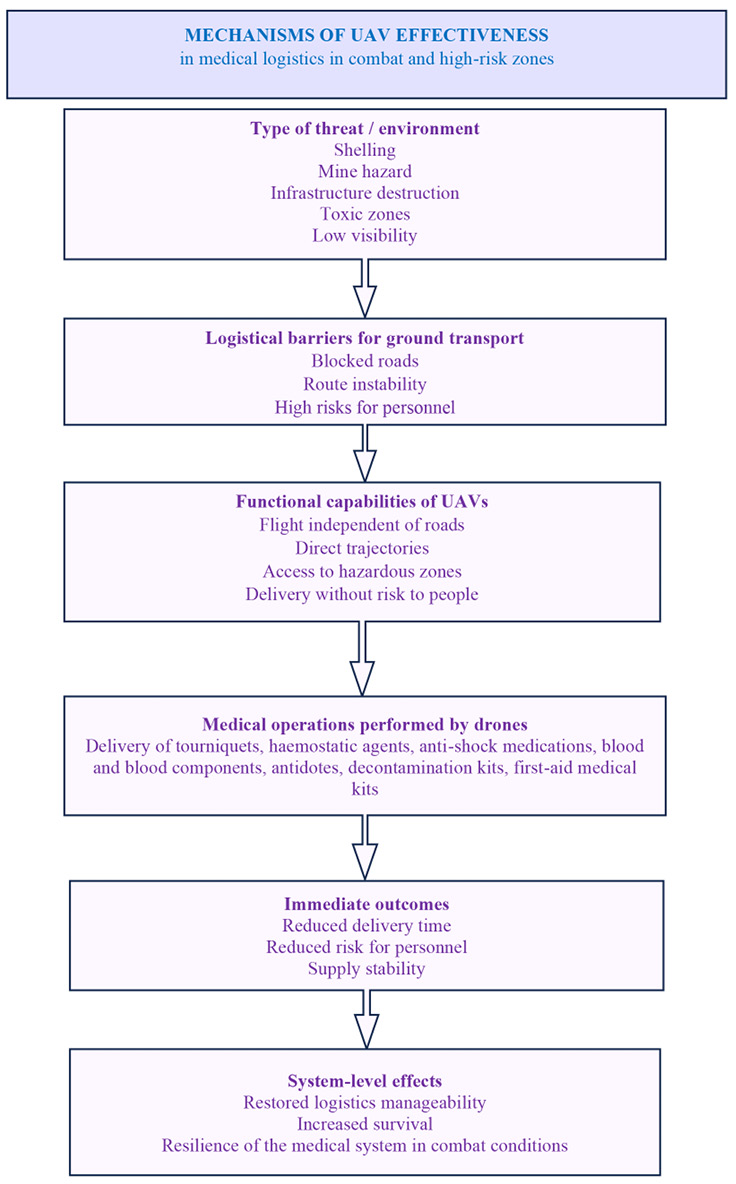
The theoretical analysis further demonstrated that drones provide high-precision aerial reconnaissance of minefields, areas under active shelling, as well as low-visibility sectors, generating reliable data for planning safe evacuation routes and medical-resource transport [27,63]. It has additionally been found that integration of thermal imaging sensors and automated threat-detection algorithms reduces the time that people spend in hazardous sectors, thus minimising secondary-injury risk and increasing the speed of tactical decision-making [35,64]. Taken together, these results show that UAVs create an autonomous, low-risk medical logistics channel through which medical cargo reaches forward positions regardless of the ground-route availability. A comparison of these findings with the conclusions of C. Wankmüller et al. [14] shows that, in cross-border operations, unmanned systems support the continuity of medical supply chains when the traditional transport loses functionality, thus complementing the results. In Ukraine, drones deliver tourniquets, anti-shock agents, and haemostatic medicines to the front line when the ground logistics is blocked by shelling, which fully reproduces the documented trends and underscores the critical role of the air segment in preserving access to medical care. To systematise the identified mechanisms of effectiveness, an integrated flowchart was developed to reflect the causal links between the threat type, ground-infrastructure availability, functional capabilities of unmanned platforms, and the effectiveness of medical operations in the combat zone (Figure 1).
The diagram analysis shows that drone effectiveness in combat conditions is driven by their ability to match the specific threat profile that creates breaks/disruptions in traditional logistics routes. Each hazard type (from shelling to toxic zones or minefields) generates its own set of constraints, and unmanned platforms compensate through their autonomy, independence from the ground routes, and the ability to deliver resources along (more) direct trajectories [65,66]. Within this logic, drones function as a tactical adaptation tool enabling medical structures to maintain operational controllability despite rapid situational changes. The diagram also shows that, as the threat level rises, drone systems shift from a supporting tool to a determining mechanism of access to medical interventions, because they can reduce uncertainty and ensure decision stability in environments where informational and logistics control has been partially lost.
The section’s synthesis indicates that, in combat and high-risk environments, drones create a new architecture of medical support in which the key factor is not merely overcoming the infrastructure constraints but the timely execution of clinically significant interventions – such as delivering tourniquets, haemostatics, blood, antidotes, anti-shock agents, and emergency kits to high-threat sectors. This functional orientation explains their growing role in early stabilisation of casualties, shortening intervals to provision of first aid, and minimising repeated threats to the personnel involved. The experience of the Russo-Ukrainian war further underscores that UAVs are becoming an integral component of medical support for forward units, ensuring access to therapeutic resources in situations where other mechanisms cannot be implemented. In an integrated sense, it has been established that drones increase survival chances under critical conditions and set new standards for organising medical care, while expanding operational response capabilities in conflicts and extreme-risk zones.
Regulatory and operational constraints on integrating medical drones into the European airspace are determined by a combination of flight-safety requirements, digital integration, and ethical standards for handling sensitive medical data [40]. The analysis shows that the U-Space concept is viewed as an institutional framework for managing unmanned traffic in low-altitude airspace, where medical drones must operate under dense coordination with other users [7]. In this context, regulatory frameworks define the limits of autonomy, permissible operational density, and liability arrangements, and therefore determine whether medical unmanned systems can move from local experiments to an infrastructure-level solution in healthcare systems [26,67,68].
Beyond regulatory requirements, drone deployment in remote disaster environments is constrained by aircraft-level and infrastructure-level factors. Limited load-carrying capacity, a restricted flight range, and reduced operability under adverse weather conditions are recognised barriers to rural healthcare drone systems [21,69,70]. These constraints are particularly important for blood products, emergency kits, and other payloads whose mass, packaging, or temperature-control requirements may reduce their effective range or mission flexibility. Communication reliability is another critical limitation: remote identification, telemetry, command continuity, and trajectory monitoring depend on stable data links, whereas infrastructure-poor settings may experience connectivity and telemetry disruptions [48,71–73]. Consequently, operational planning should match the payload to available range, define weather-dependent flight limits, provide communication redundancy wherever feasible, and maintain fallback transport options when safe UAV operation cannot be ensured.
The analysis indicates that one fundamental barrier to integrating medical drones into U-Space is strict requirements for platform certification, operator approval procedures, and mandatory real-time identification of aircraft, thus creating a high entry threshold for medical providers [69,74]. It has also been established that medical operators must adapt to a multi-layer permitting system that combines aviation, medical, and general administrative regulation, consequently slowing down the transition from pilot projects to regular services [49]. These findings align with those of P. Garcia et al. [58], who emphasised that, without stringent certification procedures and regulatory oversight, the use of drones in pre-hospital care creates unacceptable risks for patients and civilians, thus supporting the identified high entry threshold. At the same time, S. Kumar and A. Khan [53] pointed to the opposite aspect: excessive regulatory strictness can become a structural obstacle to implementing automated supply systems, especially in resource-constrained countries.
The reviewed data show that the integration of medical drones into the U-Space environment is possible only if unmanned platforms are interoperable with digital air-traffic management services, particularly for remote identification, geospatial support, and automated trajectory monitoring [16,62]. It has also been established that U-Space stability depends on the reliability of data transmission channels and the capability of systems to detect and prevent route conflicts in real time, making autonomous medical flights vulnerable in the absence of unified communication protocols [72]. This is consistent with the conclusions of M.R. Grabowski et al. [71] who showed that remote and infrastructure-poor UAS operations remain vulnerable to limited connectivity, telemetry constraints, and airspace-integration challenges, reinforcing the need for resilient communication and human-autonomy coordination. T. Lakhwani et al. [48] stressed that the integration of IoT platforms and drones into healthcare logistics networks faces practical constraints linked to the heterogeneity of technical standards and uneven digital infrastructure across regions. This difference in emphasis shows that technical compatibility in the U-Space context is an institutional challenge of equalising digital capabilities across territories.
The identified patterns indicate that the integration of medical drones into U-Space is accompanied by pronounced ethical barriers related to personal data protection, particularly when transporting biological samples, transmitting patient telemetry, and recording patient location in real time [75,76]. It has additionally been established that unresolved responsibility and liability for incidents involving autonomous drones complicate contracting between operators, medical facilities, and insurers in emergencies [49,68]. A comparison of these findings with the conclusions of M. Poljak and A. Šterbenc [47] yields a shared conclusion: the authors demonstrated that the drone use in clinical microbiology and infectious diseases is impossible without clear rules for storing and processing sensitive data, thus confirming the ethical vulnerability identified for U-Space. Conversely, R. Graboyes et al. focus on the politico-legal dimension, while emphasising that unresolved liability and insurance issues in cases of crashes or privacy breaches are a key reason for the regulators’ cautious stance towards medical unmanned systems.
In civilian disaster zones, autonomy introduces patient-safety and accountability issues beyond privacy alone. Autonomous or semi-autonomous routing can reduce the operator workload, but safety-critical operations require defined human oversight, operational limits, and contingency procedures for any potential loss of navigation or communication [58,71]. For medical deliveries, the patient safety also depends on accurate delivery to the intended location, preservation of the payload integrity, and the ability to interrupt or redirect a mission if the conditions (have) become unsafe. When the patient telemetry, geolocation data, or information linked to biological samples is transmitted, data collection should be limited to operationally necessary information, and access should be controlled in accordance with applicable data-protection requirements [6,47,76]. Responsibility for incidents involving autonomous systems should also be defined in advance between the UAV operator and the healthcare organisation, because unresolved liability and insurance arrangements remain a barrier to routine deployment [49,77].
The analysis has also established that U-Space operational requirements – such as continuous flight monitoring, qualified personnel for higher autonomy levels, and support of dispatch centres – complicate the upscaling of medical drone services to national or cross-border networks [7,69,72,73]. It has also been found that even technically successful pilot projects often remain confined to limited geographic areas due to the high cost of compliance, integration into already existing logistics processes, and maintenance of the digital infrastructure [48]. For rural and low-income regions, barriers include regulatory constraints, funding shortages, and insufficient institutional readiness to deploy complex unmanned systems. These data align with those accrued by V. Uvarova [79], showing that logistics systems in war and crisis conditions are highly sensitive to regulatory and organisational constraints, thus supporting the conclusion about scaling vulnerability in complex environments. At the same time, a comparison of these findings with those of S. Aggarwal et al. [41] highlights an important intersection: the authors also determined that the economic viability of drone services is shaped by external conditions, but they emphasised the central role of political support, infrastructure subsidisation, and regulatory relaxations as factors that can offset high initial technology costs. In contrast to the conclusion about the U-Space’s constraining effect, they showed that, in low-density populations and where traditional logistics routes are expensive, drones can generate economies of scale, i.e., reduce unit delivery costs as the number of flights increases.
Future development is likely to move from isolated drone missions towards adaptive, networked logistics systems [80]. AI-supported navigation and risk-based path planning may improve route selection in dynamically changing air-ground environments [27,73], while swarm coordination may allow multiple UAVs to distribute tasks, provide redundancy, and maintain the supply when a single route or platform becomes unavailable. Hybrid air-ground systems can allocate lightweight, time-critical consignments to UAVs while retaining ground vehicles for heavier loads and tasks requiring greater transport capacity [17,24]. Over the next decade, these technologies may improve scalability and resilience, but their medical value will depend on validated safety procedures, reliable communication, interoperability with traffic-management systems, and regulatory approval rather than on technological capability alone [7,71].
Synthesising the analysis allows the conclusion that U-Space regulatory, technical, and ethical requirements define the boundaries of possible medical-drone development in Europe. Certification, digital interoperability, data protection, and operator liability have been identified as the key barriers limiting flight autonomy and complicating the transition to large-scale programmes. All reviewed sources confirm that, without regulatory harmonisation, medical drones will remain predominantly pilot-level initiatives rather than a systemic healthcare tool. At the same time, the analysis shows that U-Space can become a basis for safe and controlled drone deployment if the regulatory policy is adapted to medical scenarios. Thus, U-Space is not only a barrier but also a potential accelerator of medical aeromobility development.
The results confirm that drones systematically reduce delivery time intervals for critical resources across medical scenarios, by providing an acceleration of 27–43%. These figures indicate that the air segment minimises structural delays that cannot be eliminated by ground channels and increases the likelihood of timely therapeutic intervention. Across the reviewed scenarios, this effect was associated with direct routes, a reduced dependence on road conditions, and fewer intermediate stages; however, its magnitude remains dependent on the weather, payload, communication reliability, and the mission context. The analysis showed that drones strengthen the healthcare logistics resilience, while maintaining the supply continuity even when the conventional infrastructure fails due to destruction, overload, or epidemiological restrictions. Drone services compensate for the loss of ground channels, support intra- and inter-hospital routes, and reduce the operational burden on the staff. These results indicate that UAVs act as a backup and stabilisation mechanism ensuring an access to critical resources at moments of peak systemic disruption risk and removing bottlenecks inaccessible to conventional logistics.
The results also demonstrate that, in combat and high-risk environments, drones restore logistics functionality where ground routes become unusable due to shelling, mining, toxic threats, or infrastructure destruction. The synthesis shows that UAVs reduce personnel exposure to hazards, provide faster access to forward points, and support autonomous delivery channels resilient to combat factors. These findings indicate that drones are most appropriately considered a complementary rapid-response component rather than a universal substitute for the conventional transport, particularly because heavier loads, patient transport, and missions requiring direct clinical support may still depend on ground or crewed air services. The analysed data indicate that any upscaling of medical drones in the European airspace substantially depends on the complexity of regulatory requirements, including platform certification, digital interoperability, continuous flight monitoring, and strict U-Space compliance. Technological readiness is not decisive: regulatory and organisational conditions define the boundaries of the real-world use and the pace of transition from pilots to stable services. Ultimately, regulatory barriers determine the viability and integration speed regardless of proven medical effectiveness.
A limitation of the study is the use of heterogeneous secondary data from published sources and the absence of a formal risk-of-bias scoring tool, which limit direct comparability of numerical findings and may fail to fully capture variability in unsuccessful or unpublished operational deployments. Differences in the study design, operational setting, comparator type, payload, and environmental conditions also restrict direct extrapolation across contexts. In addition, the reviewed evidence did not provide standardised head-to-head estimates of the drone-versus-helicopter cost-effectiveness and response time for equivalent missions. Further research should include prospective field trials and economic evaluations in different regulatory, environmental, and risk settings to quantify comparative effectiveness, operational reliability, and integration requirements for U-Space and multimodal emergency logistics.
The author declares no conflicts of interest.