Acta medica Lituanica ISSN 1392-0138 eISSN 2029-4174
2026. Vol. 33. No 2. Online ahead of print DOI: https://doi.org/10.15388/Amed.2026.33.2.18
Anne Mary John
Department of Physical Medicine and Rehabilitation, Believers Church Medical College Hospital, Thiruvalla, Kerala, India
Department of Physical Medicine & Rehabilitation, Kasturba Medical College Mangalore, Manipal Academy of Higher Education, Manipal, India
E-mail: annemaryjohn@gmail.com
ORCID ID https://orcid.org/0009-0009-2181-3784
ROR https://ror.org/048vk1h54
Vijaya Kumar K*
Department of Physiotherapy, Manipal College of Health Professions Mangalore, Manipal Academy of Higher Education, Manipal, India
E-mail: vijay.kk@manipal.edu
ORCID ID https://orcid.org/0000-0003-4937-7442
ROR https://ror.org/048vk1h54
Kuldeep Deka
Department of Physiotherapy, Manipal College of Health Professions Mangalore, Manipal Academy of Higher Education, Manipal, India
E-mail: kuldeep.deka@manipal.edu
ORCID ID https://orcid.org/0000-0002-5117-2692
ROR https://ror.org/048vk1h54
Shyam Krishnan K
Department of Physiotherapy, Manipal College of Health Professions Mangalore, Manipal Academy of Higher Education, Manipal, India
E-mail: krish.shyam@manipal.edu
ORCID ID https://orcid.org/0000-0001-7046-8619
ROR https://ror.org/048vk1h54
Megha M Nayak
Department of Physiotherapy, Manipal College of Health Professions Mangalore, Manipal Academy of Higher Education, Manipal, India
E-mail: megha.mnayak@manipal.edu
ORCID ID https://orcid.org/0000-0003-0950-9893
ROR https://ror.org/048vk1h54
Hritika D Pai
Department of Physiotherapy, Manipal College of Health Professions Mangalore, Manipal Academy of Higher Education, Manipal, India
E-mail: hritika.mchpmlr2022@learner.manipal.edu
ORCID ID https://orcid.org/0000-0002-4647-9526
ROR https://ror.org/048vk1h54
Nishanth Gowda H.L
Department of Physiotherapy, Manipal College of Health Professions Mangalore, Manipal Academy of Higher Education, Manipal, India
E-mail: nishanthgowdahl77@gmail.com
ORCID ID https://orcid.org/0009-0006-9615-3184
ROR https://ror.org/048vk1h54
Abstract. Background: Individuals with traumatic spinal cord injury (SCI) experience complex physical, psychological, and social challenges that may affect health-related quality of life (HRQoL). This study investigated the associations of caregiver burden and physical activity with HRQoL among individuals with traumatic SCI in India.
Materials and methods: This cross-sectional study analyzed data collected during a state-level rehabilitation meeting in Karnataka, India, in September 2023. Although adults of either sex were initially eligible, incomplete data resulted in the exclusion of all female participants; consequently, the final analytical sample comprised male participants with traumatic SCI. Quality of Life was assessed by using the Short Form Health Survey (SF-12) to derive physical and mental component summaries. Physical activity and caregiver burden were measured by using the International Physical Activity Questionnaire-Short Form (IPAQ-SF) and the Zarit Burden Interview-Short Form (ZBI-12), respectively. Descriptive statistics and Spearman rank correlation coefficients were used to examine associations among the study variables.
Results: Among 94 males with traumatic SCI, the mean age was 39.2 ± 10.1 years, and 69.1% had thoracic lesions. Spearman’s correlation analysis revealed that age at injury weakly and negatively correlated with SF-12 PCS (rho = -0.220, p = 0.039), and higher caregiver burden (ZBI-12) demonstrated a significant, moderate negative correlation with SF-12 mental component (rho = -0.388, p = 0.003) and total SF-12 (rho = -0.321, p = 0.015).
Conclusion: In this sample of male participants with traumatic SCI, the quality of life was affected by an older age at the time of injury and caregiver burden, rather than physical activity. Given the cross-sectional design, substantial participant attrition, absence of multivariable adjustment, and exclusion of all female participants, these findings should be interpreted cautiously, and prospective studies using SCI-specific outcome measures and appropriately powered multivariable analyses are warranted.
Keywords: quality of life, physical activity, caregiver burden, spinal cord injury.
Santrauka. Įvadas: Asmenys, patyrę nugaros smegenų traumą (NST), susiduria su sudėtingais fiziniais, psichologiniais ir socialiniais iššūkiais, kurie gali turėti įtakos su sveikata susijusiai gyvenimo kokybei (HRQoL). Šiame tyrime buvo nagrinėjami globėjų naštos ir fizinio aktyvumo ryšys su HRQoL NST patyrusių asmenų Indijoje.
Medžiaga ir metodai: Šiame skerspjūvio tyrime buvo analizuojami duomenys, surinkti 2023 m. rugsėjo mėn. Karnatakoje, Indijoje, vykusio valstijos lygio reabilitacijos susitikimo metu. Nors iš pradžių tyrime galėjo dalyvauti abiejų lyčių suaugusieji, dėl neišsamių duomenų visos moterys iš tyrimo imties buvo pašalintos; todėl galutinę analizės imtį sudarė vyrai, turintys trauminę SCI. Gyvenimo kokybė buvo vertinama naudojant „Short Form Health Survey“ (SF-12) klausimyną, siekiant atlikti fizinės ir psichinės jų sveikatos komponentų apibendrinimą. Fizinis aktyvumas ir globėjų našta buvo matuojami atitinkamai naudojant „International Physical Activity Questionnaire-Short Form“ (IPAQ-SF) ir „Zarit Burden Interview-Short Form“ (ZBI-12). Tyrimo kintamųjų ryšiui ištirti naudota aprašomoji statistika ir Spearmano rangų koreliacijos koeficientai.
Rezultatai: 94 vyrų, patyrusių stuburo smegenų traumą, vidutinis amžius buvo 39,2±10,1 metų, o 69,1 % iš jų turėjo krūtinės ląstos pažeidimus. Spearmano koreliacijos analizė parodė, kad amžius traumos metu silpnai ir neigiamai koreliavo su SF-12 fizinės sveikatos komponentu (rho = -0,220, p = 0,039), o didesnė globėjų našta (ZBI-12) parodė reikšmingą, vidutinio stiprumo neigiamą koreliaciją su SF-12 psichinės sveikatos komponentu (rho = -0,388, p = 0,003) bei bendru SF-12 rezultatu (rho = -0,321, p = 0,015).
Išvada: Šioje NST patyrusių vyrų imtyje gyvenimo kokybei turėjo įtakos vyresnis amžius traumos metu ir slaugytojų našta, o ne fizinis aktyvumas. Atsižvelgiant į skerspjūvio tyrimo dizainą, didelį dalyvių iškritimą, daugiamatės korekcijos nebuvimą ir visų moterų dalyvių neįtraukimą, šiuos rezultatus reikėtų vertinti atsargiai, o ateityje būtina atlikti perspektyviuosius tyrimus, kuriuose būtų naudojami specifiniai nugaros smegenų sužalojimui skirti rezultatų rodikliai ir atitinkamo statistinio galingumo daugiamatės analizės.
Raktažodžiai: gyvenimo kokybė, fizinis aktyvumas, našta globėjams, nugaros smegenų trauma.
_________
* Corresponding author
Received: 23/04/2026. Revised: 24/09/2026. Accepted: 28/09/2026
Copyright © 2026 Anne Mary John, Vijaya Kumar K, Kuldeep Deka, Shyam Krishnan K, Megha M Nayak, Hritika D Pai, Nishanth Gowda H.L. Published by Vilnius University Press.This is an Open Access article distributed under the terms of the Creative Commons Attribution License, which permits unrestricted use, distribution, and reproduction in any medium, provided the original author and source are credited.
Spinal Cord Injury (SCI) is a devastating condition that strongly impacts a person’s physical, mental, social, and emotional well-being. Most SCI cases involve young or middle-aged men who are in the prime of their lives [1,2]. Although people with SCI are known to have a higher mortality rate and a shorter lifespan than the general population, the 10-year survival rate is between 81% and 93% [3]. Therefore, it is imperative to address aspects of quality of life, given the possibility of a long life and the variety of challenges a person with SCI may encounter.
The WHO defines quality of life (QoL) as “individuals’ perception of their position in life in the context of the culture and value systems in which they live and in relation to their goals, expectations, standards and concerns” [4]. Individuals with SCI typically have a lower QoL than the general population [5]. Although QoL is subjective, various common factors often contribute to it, and multiple studies have been conducted across the world to understand it. Some of the biopsychosocial factors that affect QoL in SCI patients are as follows: physical factors, such as age, level of injury, dependent mobilization, pain, bladder and bowel issues, and problems in sexual life [6,7]; personal factors, such as marriage, higher education, age at injury, and the duration of injury [8]; psychological factors, such as negative affect and posttraumatic cognitions [9]; and social factors, such as the socioeconomic status, financial status, employment, and accessibility [6,10].
The quality of life among individuals with spinal cord injury may be influenced by a complex interplay of several known and unmeasured factors, either directly or indirectly. One of the unmeasured factors, such as physical activity, is essential for people with SCI because it helps manage existing health issues and prevents long-term complications from inactivity [11]. Evidence suggests that those with SCI experience lower energy expenditure and metabolic responses during exercise [12]. This underscores the need for them to participate in physical activity to support their health and well-being. The question remains whether an individual’s QoL improves when a person with SCI engages in some form of physical activity. The existing literature indicates a positive correlation between physical activity and the quality of life.
Caregiver burden has been shown to have a negative effect on the QoL of caregivers [13,14]. However, only a limited number of studies have been performed to determine the association between the caregiver burden and the QoL of people with SCI [15].
Several studies have been carried out to assess different aspects of the quality of life for spinal cord injury patients in India [6,16,17]. A thorough review of the existing literature identified a limited number of studies examining the association between the quality of life and physical activity; moreover, evidence regarding the association between the quality of life and the caregiver burden also remains limited. In addition, the findings from other countries (especially high-income countries) cannot always be extrapolated to a study population of a low- or middle-income country [6]. Therefore, the present study aims to investigate the associations between the caregiver burden, physical activity, and the quality of life among individuals with spinal cord injury in this part of the country, i.e., the Southern coast of India, rather than establishing predictive relationships.
This cross-sectional study analyzed data obtained from individuals with spinal cord injury (SCI) who participated in a health-screening programme conducted from September 24 to 26, 2023, during a state-level Rehab Meet for individuals with traumatic SCI in collaboration with nongovernmental organizations in Karnataka, India. The programme was designed to provide health screening, rehabilitation-related education, peer networking, and multidisciplinary support to individuals living with SCI. A multidisciplinary team comprising specialists in physical medicine and rehabilitation, physiotherapists, rehabilitation nurses, physicians, surgeons, and medical social workers conducted the health screening and clinical assessments.
Demographic information and self-report questionnaires were completed by the participants, with assistance from the study team whenever required. Neurological and functional assessments were subsequently conducted by the medical and rehabilitation team. Following the completion of the programme, the available assessment datasheets were systematically reviewed for completeness. Because the present analysis required complete information for the prespecified variables and clinical assessments, the participants with missing information were excluded from the analytical sample.
Individuals aged >18 years of either sex with a history of acquired SCI were eligible for inclusion. The participants were excluded from the present analysis if they provided incomplete questionnaires, essential demographic information was missing, or neurological or functional assessment data required for the planned analyses were incomplete. Missing information arose during the programme-level data collection process, in which the participants completed multiple questionnaires and underwent several clinical assessments.
The collected data were pseudonymized to protect participant confidentiality. Of the 165 individuals initially identified from the programme records, 152 were men, and 13 were women. After an assessment of data completeness, 94 participants were retained for the present analysis. Seventy-one participants (58 men and 13 women) were excluded because of incomplete information required for the planned analyses. Thus, all female participants were excluded during the data-completeness screening, resulting in an exclusively male analytical sample.
Listwise deletion was used because the analyses required complete information for the relevant variables. However, the extent and pattern of missing data may have introduced selection bias. In particular, the complete exclusion of female participants resulted in a substantial sex imbalance between the initial programme population and the analytical sample. Therefore, the findings should be interpreted as applicable to the included participants and should not be assumed to be representative of the broader population of individuals living with SCI.
The information acquired from the participants’ medical records included the following: the current age, age at injury, marital status, education, level and severity of the injury, and post-injury management. The independent variable measures included the Zarit Burden Interview (ZBI) and the International Physical Activity Questionnaire-Short Form (IPAQ-SF), while the dependent variable was assessed by using the Short Form Health Survey (SF-12).
The IPAQ-SF is a seven-item questionnaire aimed at assessing an individual’s physical activity over the previous week. It covers activities of different intensities, while considering both their frequency and duration. Even though it does not specifically capture rehabilitation-related activities, it provides a quick and standardized overview of overall physical activity levels.
The ZBI-12 consists of 12 questions completed by the primary caregiver, addressing physical and emotional health, social life, and relationships, thereby providing insight into caregiver burden.
The SF-12, which is a brief, standardized generic health status measure comprising 12 items that assess physical and mental aspects of health, delivers responses which are summarized into two component scores: the Physical Component Summary (PCS) and the Mental Component Summary (MCS) scores, with higher scores generally indicating better perceived health.
The ZBI, IPAQ-SF, and SF-12 are standardized and widely used instruments, and previous studies have evaluated their reliability and validity across different populations [18–20]; The standardized versions of these instruments were therefore used in the present study, and their established psychometric evidence was considered when interpreting the results.
The data obtained were analyzed by using Jamovi (V2.3.24) statistical analysis software. An exploratory analysis was initially conducted, and the results were presented by using descriptive statistics. Quantitative variables were summarized as means and standard deviations, whereas qualitative variables were described by using frequency distributions and proportions. The strength and direction of the associations between the study variables and self-reported health-related quality of life (HRQoL) were assessed by using Spearman’s rank correlation coefficient. Statistical significance was set at p < 0.05.
Data were collected from the medical records of a total of 94 males with traumatic SCI, with a mean age of 39.2 ±10.1 years. In the population under study, 49 (52.1%) were single, and only 46 (48.9%) had completed their university degree. The majority of the individuals, i.e., 65 (69.1%), had lesions at the thoracic level, and 76 (80.9%) had undergone surgical management of SCI. The demographic characteristics of the subject population are given in Table 1.
|
Characteristic n=94 |
Mean ±SD |
|
|
Age (years) n=94 |
39.2 ±10.1 |
|
|
Age at injury n=88 Missing=6 |
28.4 ±10.9 |
|
|
Frequency (n) |
Percentage (%) |
|
|
Marital Status |
||
|
Single |
49 |
52.1% |
|
Married |
43 |
45.7% |
|
Divorced/Separated |
2 |
2.1% |
|
Education |
||
|
Illiterate |
6 |
6.4% |
|
Primary |
15 |
16% |
|
Secondary |
27 |
28.7% |
|
University |
46 |
48.9% |
|
Level of Lesion |
||
|
Cervical |
19 |
20.2% |
|
Thoracic |
65 |
69.1% |
|
Lumbar |
10 |
10.6% |
|
Severity of Lesion (ASIA Impairment Scale) |
||
|
A |
58 |
61.7% |
|
B |
6 |
6.4% |
|
C |
30 |
31.9% |
|
D |
- |
- |
|
E |
- |
- |
|
Management |
||
|
Conservative |
18 |
19.1% |
|
Surgical |
76 |
80.9% |
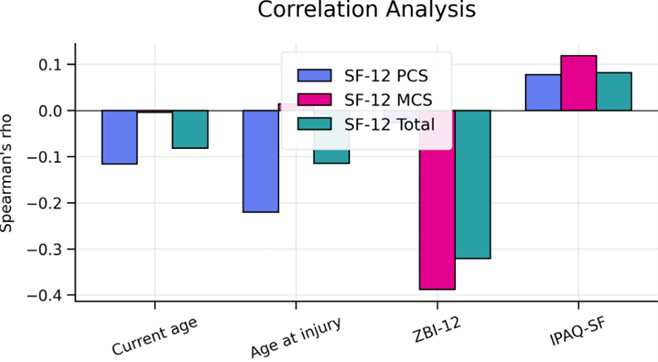
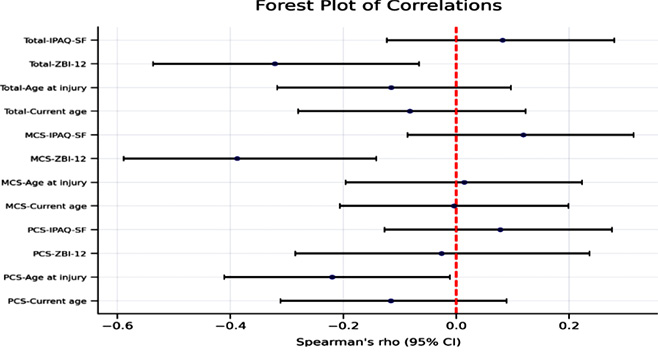
The median and interquartile ranges were calculated for both dependent and independent variables. Table 2 presents the descriptive statistics for these variables. Spearman’s rank-order correlation analyses allowing to examine the association between QoL and demographic and clinical characteristics are depicted in Table 3. Physical health (SF-12 PCS) demonstrated a significant, weak negative correlation with age at the time of injury (rho = -0.220, 95% CI [-0.411, -0.011], p = 0.039), thus indicating that an older age at injury was associated with worse physical outcomes. However, the current age, burden (ZBI-12), and physical activity (IPAQ-SF) were not significantly related to SF-12 PCS. Mental health (SF-12 MCS) demonstrated a significant, moderate negative correlation with the Zarit Burden Interview (ZBI-12) scores (rho = -0.388, 95% CI [-0.589, -0.142], p = 0.003), indicating that higher caregiver- or subjective-burden was strongly associated with poorer mental health outcomes. Similarly, overall, the SF-12 Total score was significantly and negatively correlated with the ZBI-12 scores (rho = -0.321, 95% CI [-0.537, -0.066], p = 0.015), as illustrated in Figures 1 and 2 featuring a grouped bar chart showing Spearman’s correlation coefficients (ρ) between clinical variables (the current age, age at injury, ZBI-12, and IPAQ-SF) and SF-12 outcomes (PCS, MCS, and Total scores), and a forest plot presenting the statistical effect sizes (Spearman’s ρ) together with 95% confidence intervals and significance, respectively.
|
Median |
IQR |
|
|
ZBI-12 |
5.00 |
6.00 |
|
IPAQ-SF |
1363 |
3282 |
|
SF-12 (MCS) |
39.4 |
10.5 |
|
SF-12 (PCS) |
37.2 |
8.77 |
|
SF-12 (Total) |
76.5 |
12.7 |
|
Current age |
Age at the time of injury |
ZBI-12 |
IPAQ-SF |
||
|
SF- 12 (PCS) |
Spearman’s rho df p-value 95% CI |
-0.116 92 0.266 [-0.311, 0.089] |
-0.220* 86 0.039 [-0.411, -0.011] |
-0.026 55 0.846 [-0.285, 0.236] |
0.078 92 0.457 [-0.127, 0.276] |
|
SF-12 (MCS) |
Spearman’s rho df p-value 95% CI |
-0.004 92 0.968 [-0.206, 0.199] |
0.014 86 0.895 [-0.196, 0.223] |
-0.388** 55 0.003 [-0.589, -0.142] |
0.119 92 0.253 [-0.086, 0.314] |
|
SF-12 (Total) |
Spearman’s rho df p-value 95%CI |
-0.082 92 0.430 [-0.280, 0.123] |
-0.115 86 0.288 [-0.317, 0.097 |
-0.321* 55 0.015 [-0.537, -0.066] |
0.082 92 0.430 [-0.123, 0.280] |
Identification of the factors that impact the quality of life is undoubtedly the first step in enhancing it. This would allow rehabilitation specialists and policymakers to ensure that definitive measures are taken to improve the QoL of individuals with SCI. The results of the current study reveal the absence of a relationship between physical activity and QoL among individuals with SCI. These results contrast with those of other studies reporting that physical activity is strongly correlated with the QoL in adults with SCI [21,22]. A study from Brazil showed that the inclusion of sports activities improved the QoL in the physical, psychological, and social domains [23].
However, a few studies have reported results similar to ours. Some interventional studies have concluded that gait training [24], active upper limb exercises [25], or arm ergometry [26] to improve physical activity during the rehabilitation period are not significantly associated with the QoL domains. A cross-sectional exploratory study revealed that no relationship exists between subjective QoL scores, fitness, and physical activity, and the authors concluded that the lack of a relationship between activity variables and subjective QoL may be related to the global nature of the measure used [27].
This discrepancy in the quality of life (QoL) findings may be attributed primarily to variation in outcome measures utilized across studies, and secondarily to the inclusion of individuals with spinal cord injury (SCI) at distinct phases of their rehabilitation programs.
Interestingly, the non-significant association observed between physical activity levels and the quality of life may be driven by several context-specific factors. First, profound structural and environmental barriers in India – including limited physical accessibility, a lack of adaptive recreational infrastructure, and scarce community-based rehabilitation programs often turn physical activity into a logistical challenge. Second, deep-seated attitudinal barriers toward exercise likely contributed to this finding; notably, a nationwide study revealed that 54.4% of the healthy Indian population is physically inactive, with fewer than 10% engaging in recreational physical activity [28]. Finally, the quality of life in this cohort may be more heavily dictated by immediate financial stability, robust familial support systems, and psychological coping mechanisms than by physical exercise capacity alone. Additionally, research has shown that the number of Indians who return to work or employment after a spinal cord injury is low [29].
A difference in the perspective of Indians toward the QoL might also account for our findings. A systematic review focused on the impact of SCI on the QoL revealed that the quality of life is influenced by more than just injury-related factors or individual characteristics. It is also shaped by people’s living conditions, including where they ‘grow, live, work, and age’ and the resources available to help them cope with their disability [30]. A study from Indonesia concluded that the perspective on the QoL was heavily influenced by social, cultural, and religious factors [31]. Research has emphasized that it is crucial to recognize regional understanding of the QoL and its components before assessing the QoL or life satisfaction [31]. They also noted that an individual’s concept of wellbeing is based on societal views toward disability and is deeply affected by the discrimination they might face as a person with disability.
Although global comparative studies have concluded that the SCI population living in a lower socioeconomic stratum tends to have a lower QoL, a few studies from India have reported that the quality of life among this population ranges from ‘good’ to ‘fair’ [16,17]. For instance, a study from Sri Lanka reported that, despite experiencing relatively poor physical and psychological health, individuals with paraplegia maintained a high quality of life (QoL) scores in family and social relationships, which is a finding attributed to strong familial support systems [32].
An alternative explanation for good QoL scores is that people in resource-limited countries often have lower expectations about different areas of life and tend to be more content with their circumstances [33]. Therefore, factors such as strong familial bonds, living in multigenerational households, and greater contentment with their life situations may positively impact an individual’s QoL [32,33]. Consequently, the construct of the quality of life (QoL) and its associated determinants must be interpreted within a specific sociocultural framework. Findings from a single-center or localized study may lack global generalizability unless validated by multicentric research across diverse cultural cohorts.
In our study, the caregiver burden was also shown to have a significant negative correlation with the MCS scores of the SF-12, thereby implying that a high caregiver burden was associated with a low QoL in individuals with SCI. Notably, several studies have confirmed a negative relationship between the caregiver burden and a patient’s QoL in persons with non-SCI conditions such as cancer, stroke, scoliosis, and chronic illnesses [34–37]. Existing literature has also shown that caregivers of individuals with SCI experience a significant caregiver burden along with a lower QoL [38,39].
However, relatively few studies have compared the QoL of individuals with SCI to the characteristics of the caregiver. One such study that examined the link between the QoL of youth with SCI and caregiver characteristics revealed that there was no significant association between the caregiver burden and the health-related QoL of the affected individual [40]. A study from Colombia examining the relationship between the QoL of people with SCI and the mental health of their caregivers did not reveal a correlation between these two variables [15]. However, Kim et al. noted a negative correlation between the QoL and the caregiver burden in their investigation of the relationship between the activities of daily living (ADL) in individuals with SCI and variables such as caregiver strain, QoL, and presenteeism [41].
The observed association between the QoL of individuals with SCI and the caregiver burden underscores the profound influence of the Indian sociocultural environment. In contrast to more individualistic societies, the Indian culture emphasizes family unity and collective responsibility. Consequently, the individual remains deeply interconnected with, and nearly inseparable from, the family unit [42]. When a devastating illness such as Spinal Cord Injury occurs, the primary caregiver often assumes an extraordinary level of responsibility, providing extensive care and support to the affected individual. When the QoL of a person with SCI worsens, the caregiver faces heightened stress.
Multiple correlation analyses were performed between the demographic variables and the quality of life, and the only variable that showed a statistically significant association with the QoL was the age at the time of injury. This finding was in line with the results of a study that examined the effect of the age of onset of SCI on ‘life satisfaction and participation’. They concluded that a lower age of onset was linked to a better level of life satisfaction [43]. On the other hand, other studies reported no disparity in the QoL or life satisfaction of people with pediatric-onset paraplegia and adult-onset paraplegia [44,45].
Our study yields several critical insights regarding QoL profiles in individuals with SCI. Most notably, the data demonstrate that the physical quality of life is heavily influenced by the age at which the injury occurred, while the mental well-being is deeply intertwined with the familial caregiver burden. Despite these important findings, the study is subject to notable methodological limitations.
First, substantial attrition occurred during data screening, with 71 participants (43.0%) excluded because of incomplete data. All 13 female participants were among those excluded, resulting in an exclusively male analytical sample. This attrition and sex imbalance may have introduced selection bias, and the possibility of non-random missingness cannot be excluded. Therefore, the findings should be interpreted cautiously, particularly with respect to their generalizability to the broader SCI population. Second, screening instruments were selected for logistical feasibility and rapid data collection but were not specifically developed or validated for SCI populations, potentially limiting their sensitivity and specificity; relying on self-reported measures may have introduced recall and social desirability biases. Third, this study did not employ multivariable modelling. As a result, we could not adequately control for potential confounding variables across demographic and clinical characteristics, and the observed associations cannot be interpreted as independent or causal relationships. Finally, the cross-sectional design of this study precludes the assessment of temporal or causal pathways. Due to the fact that outcome measures were assessed simultaneously at a single time point, the directional nature of these links remains undetermined.
Additionally, future research should employ longitudinal designs, SCI-validated metrics, multivariable modeling, and real-time completeness checks to improve data quality, establish temporal relationships, and further clarify these associations.
Beyond clarifying the factors influencing the caregiver burden and the quality of life in individuals with traumatic spinal cord injury, these findings offer important implications for the health policy and service delivery. Policymakers should integrate quality-of-life enhancement and caregiver support into comprehensive SCI rehabilitation policies. Furthermore, establishing community-based programs and long-term support services is essential to enhance community participation and overall well-being among individuals with traumatic SCI.
Among male participants with traumatic SCI included in this analysis, a greater caregiver burden was associated with a poorer mental health-related quality of life. These findings underscore the potential value of routinely assessing the caregiver burden and the health-related quality of life as components of comprehensive SCI rehabilitation. However, the findings should be interpreted cautiously given the substantial participant attrition, exclusion of all female participants, cross-sectional design, single-event recruitment, and absence of multivariable adjustment. Future prospective studies with larger samples of SCI individuals and by incorporating SCI-specific outcome measures and appropriately powered multivariable analyses are warranted to further clarify these associations.
This research did not receive any external funding.
The authors declare that they have no competing interests.
The datasets generated during and/or analyzed during the current study are not publicly available so as to protect participant privacy but are available from the corresponding author on reasonable request.
A. M. J.: Conceptualization, Methodology, Writing – Original Draft Preparation, Writing – Review & Editing.
V. K. K.: Conceptualization, Methodology, Supervision, Writing – Review & Editing.
K. D.: Methodology, Project Administration, Supervision, Writing – Original Draft Preparation.
S. K. K.: Formal Analysis, Methodology, Supervision.
M. M. N.: Data Curation, Formal Analysis, Project Administration.
H. D. P.: Data Curation, Methodology, Project Administration.
N. G. H. L.: Data Curation, Methodology, Project Administration.